Advertisement
Space.Fan — Go Beyond
ApJS · 3 HR AGO
UniverseMODEL

Solving the Mystery of Magnetar Fireballs

By Space.Fan Editorial Desk

Scientists have created new computer models to explain the intense, flickering light bursts coming from powerful, magnetic dead stars.
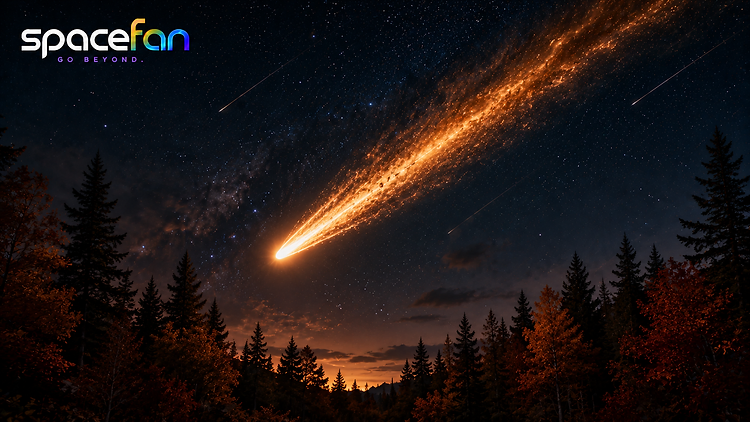
Fiery meteor streaking across the Milky Way above an autumn forest at night.
Image · Space.Fan

The Drop

s are special kinds of dead s that are incredibly dense and have magnetic fields thousands of times stronger than an ordinary magnet. Sometimes, these s suddenly shoot out intense bursts of energy that last less than a second. These events act like giant, glowing fireballs, and astronomers have been working hard to figure out exactly how they work. By using advanced computer math, a team of researchers has created new models that show how light travels away from these s. Their work includes how gravity bends light and how the 's intense magnetic field changes the way light particles, called photons, move. The team looked at how these fireballs might be shaped and how they glow in different patterns. By matching their computer models with real observations, they found that these -fireballs are likely very organized. They believe the energy comes from specific spots on the surface of the where the magnetic field is strongest, almost like a flashlight beam pointing out into space. This new way of looking at data helps explain why these bursts sometimes appear with specific patterns of color and brightness.
Advertisement

Why It Matters

These models act like a blueprint for scientists to better understand the environment around a . By confirming how these fireballs behave, researchers can use future telescope data to measure the size and weight of these dead s. This helps us learn more about how matter acts when it is squeezed into a space the size of a city but with more mass than our Sun.
Advertisement

The Catch

These findings rely on computer models, which are based on specific assumptions about how the magnetic fields and light behave. Because we cannot see the surface directly from so far away, there is still uncertainty. If the physical conditions near the are different than what the model assumes, the actual behavior of the fireballs could look quite different.

Put That in Perspective

Scientists have been studying magnetars for years, but the recent discovery of radio bursts linked to these light flashes has sparked new excitement. Researchers will now look to use future high-energy space missions to catch these flashes and test if their models match the real-world light patterns.

Source September 27, 2026
Zorawar Wadiasingh, Hoa Dinh Thi, Constantinos Kalapotharakos, Kun Hu, Matthew G. Baring, Alice K. Harding, George Younes, Sebastien Guillot, Andrea Sanna, Michela Negro, Jeremy D. Schnittman, Oliver J. Roberts, Eric Burns, Chin-Ping Hu
University of Maryland, NASA Goddard Space Flight Center, Rice University, Washington University in St. Louis, Los Alamos National Laboratory, University of Toulouse, Universita degli Studi di Cagliari, Louisiana State University, University of Galway·The Astrophysical Journal Supplement Series·10.3847/1538-4365/ae9754

Keep Exploring Space