Advertisement
Space.Fan — Go Beyond
ApJ · 19 HR AGO
Solar SystemMODEL

Solving the Mystery of Our Solar System's Outer Boundary

By Space.Fan Editorial Desk

A new computer model helps explain how the solar wind changes as it travels to the farthest edges of our space neighborhood.
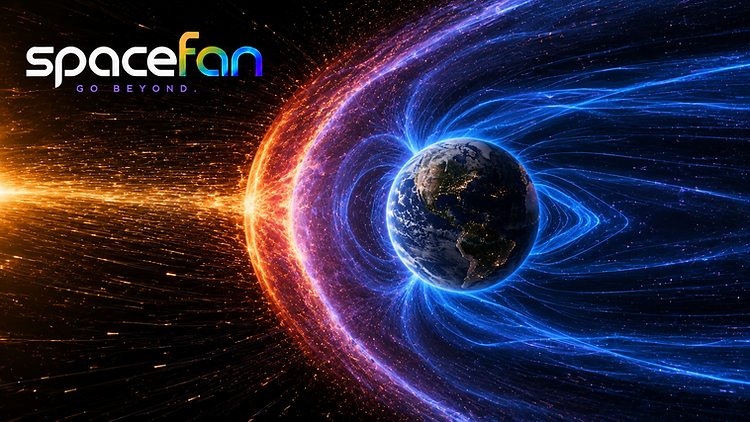
Earth surrounded by glowing magnetic field lines as solar particles strike the magnetosphere.
Image · Space.Fan

The Drop

Our Sun is constantly blowing a stream of charged particles into space, known as the solar wind. As this wind travels away from the Sun, it runs into tiny bits of gas from the space between s. This meeting creates a boundary that protects our entire solar system. Scientists have used a powerful computer program called MS-FLUKSS to create a 3D map of how this wind moves and changes as it pushes out into deep space. To build this map, researchers used data from several famous spacecraft. They gathered information from Ulysses, which studied the Sun from above and below, and the Voyager 2 probe, which is currently traveling in the distant reaches of our system. They also used newer data from the New Horizons mission, which has flown past Pluto and beyond. By comparing their computer models to the real numbers sent back by these spacecraft, the team confirmed that the wind is influenced by 'pickup ions.' These are particles that t out as neutral gas but become charged when they bump into the solar wind. The model helps explain how these particles and moving waves of energy heat up the solar wind as it reaches the edge of our system.
Advertisement

Why It Matters

Understanding the outer solar wind helps us learn how our solar system interacts with the rest of the galaxy. This model is important because it shows that even small fluctuations in the Sun's activity can have big effects on the space environment billions of miles away. It confirms that the interaction between the solar wind and interstellar gas is a complex process that shapes the shape and size of our bubble in space.
Advertisement

The Catch

This research is based on a computer model, which means it is a mathematical simulation of reality rather than a direct measurement of every corner of space. Because the outer edge of our solar system is so vast and difficult to reach, the model relies on data collected at specific points in time and space. Future observations from other probes will be needed to see if these predictions hold true in all conditions.

Put That in Perspective

Scientists have spent decades trying to map the outer heliosphere. While early ideas simplified the solar wind as a steady flow, this new work highlights how messy and active the edges of our home really are. Researchers hope to use this model to better predict how solar storms travel through the outer reaches of the solar system in the future.

Source September 19, 2026
ApJ

Keep Exploring Space