Advertisement
Space.Fan — Go Beyond
ApJ · 7 HR AGO
UniversePEER REVIEWED

Space Detectives Unmask Imposter Quasars in the Deep Universe

By Space.Fan Editorial Desk

New research shows that two suspected super-distant space objects are not what scientists originally thought.
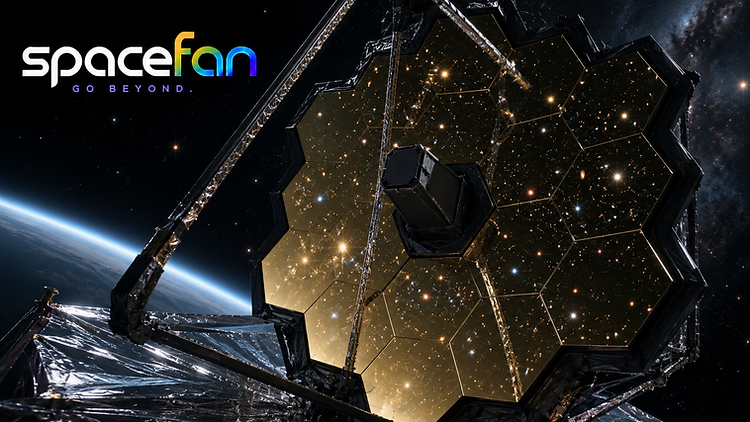
James Webb Space Telescope in space with its gold segmented mirror facing the stars.
Image · Space.Fan

The Drop

Astronomers use a technique called gravitational lensing to peer at the very distant universe. A heavy object in the foreground acts like a giant magnifying glass, bending the light of objects behind it. Recently, scientists studied two objects, called J0109–5424 and P170+20, that were thought to be distant quasars magnified by this space lens. Quasars are bright, active centers of galaxies powered by hungry s. To get a better look, researchers used the powerful James Webb Space Telescope and other ground-based observatories to analyze the light coming from these sources. By breaking the light into a spectrum—like a rainbow that reveals a or galaxy's chemical fingerprint—they could see the objects in much more detail than before. The investigation revealed that one of the objects, J0109–5424, was actually much closer to us than previously believed. It appeared distant because of special chemical signatures that mimicked the look of an early-universe object. The second object, P170+20, also did not show the signs one would expect from a gravitationally lensed source. Instead of being a magnified distant galaxy, the data pointed toward a strange mix of a normal quasar and a cool, small , though the team could not be 100 percent sure.
Advertisement

Why It Matters

Identifying true distant quasars is vital for mapping the early history of the universe. When scientists mistake a closer object for one from the very beginning of time, it can throw off calculations about how galaxies grew. By correctly classifying these objects, researchers can clean up their records and ensure their models of the early universe match reality.
Advertisement

The Catch

While the evidence suggests these are not distant lensed quasars, there is still a small amount of mystery left. The team could not completely rule out the possibility of a rare, accidental alignment between a tiny and a distant quasar for the object P170+20, even if it seems unlikely. Space is vast, and sometimes two objects just happen to cross paths from our perspective.

Put That in Perspective

Finding these imposters is part of a larger challenge in astronomy. As telescopes like the James Webb get better at seeing further away, scientists are finding more objects that look like they belong in the early universe but are actually closer. Researchers will likely keep using these high-tech tools to double-check their candidates to make sure they are measuring the true distance of these powerful light sources.

Source October 3, 2026
ApJ

Keep Exploring Space