Advertisement
Space.Fan — Go Beyond
ApJ · 2 HR AGO
UniversePEER REVIEWED

Updating How We Measure Cosmic Distances Using Exploding Stars

By Space.Fan Editorial Desk

Researchers improved how they measure distances in the universe by correcting errors in how we track the galaxies where stars explode.
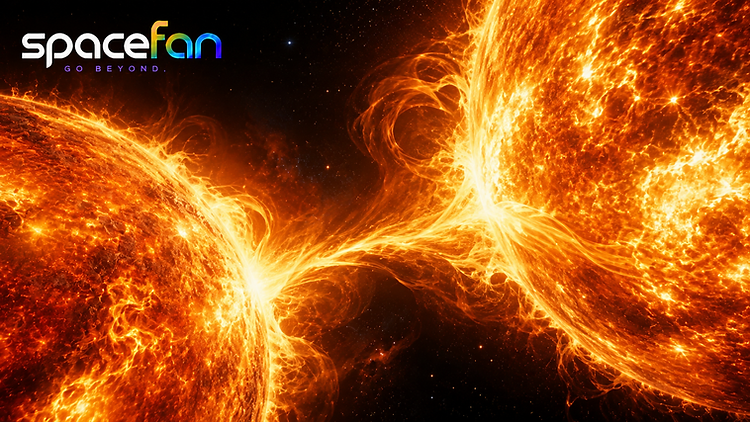
Two fiery stars interacting through huge glowing loops and streams of stellar plasma.

The Drop

When a special kind of called a Type Ia explodes, it shines with a very predictable brightness. Scientists use these explosions like cosmic yardsticks to measure how far away galaxies are and how fast the universe is expanding. However, these s are inside host galaxies, and the properties of those galaxies can sometimes make the s appear slightly brighter or dimmer than they really are. This leads to small errors in our distance calculations. To fix this, a team of scientists created a new, more consistent way to measure these host galaxies. They looked at about 2,000 e and used high-quality data from the DESI Legacy Imaging Surveys to study the host galaxies in the same way for every . By using a computer program called Prospector, they could better understand the size and makeup of each galaxy, which helps them account for the influence the galaxy has on the 's light. The researchers found that some previous studies had overestimated the size or mass of these galaxies, which skewed the results. By fixing these numbers, they brought different sets of data into much better agreement with each other.
Advertisement

Why It Matters

This work is important because it makes our map of the universe much more accurate. By reducing the small errors in our cosmic yardsticks, scientists can get a clearer picture of how dark energy behaves. Dark energy is the mysterious force that pushes the universe apart, and even tiny changes in our measurements can tell us whether our current theories about the universe are correct or if we need to rethink them entirely.
Advertisement

The Catch

While this study improves our data, it does not solve every mystery. Even with these better measurements, there is still some uncertainty about whether the universe follows the rules of the standard cosmological model perfectly. Different ways of measuring the universe still provide slightly different answers, and scientists are still working to understand if these remaining differences are due to missing information or something fundamental we do not yet understand about space.

Put That in Perspective

In the past, astronomers often used different methods to measure galaxies at different distances, which made it hard to compare their findings. This new approach provides a consistent baseline for a large group of stars. Researchers plan to use these improved methods to keep testing our theories about the universe's history and its future growth.

Source November 19, 2026
Taylor J. Hoyt, David Rubin, Greg Aldering, Saul Perlmutter, Andrei Cuceu, Ravi Gupta
University of California Berkeley, Lawrence Berkeley National Laboratory, University of Hawai’i at Mānoa·The Astrophysical Journal·10.3847/1538-4357/aeb099

Keep Exploring Space