Advertisement
Space.Fan — Go Beyond
arXiv · 4 DAYS AGO
DiscoveriesEARLY RESEARCH

Webb Telescope Reveals How Galaxies Blow Out Their Dust

By Space.Fan Editorial Desk

The James Webb Space Telescope captured a stunning look at a galaxy shooting powerful streams of dust and gas into deep space.
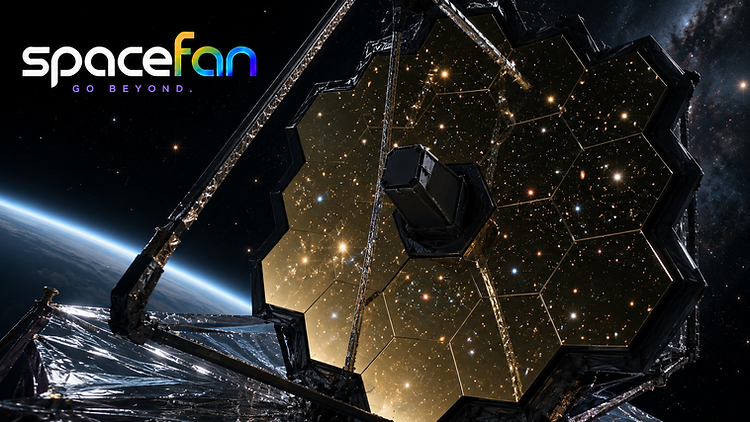
James Webb Space Telescope in space with its gold segmented mirror facing the stars.

The Drop

Astronomers used the powerful James Webb Space Telescope to get an incredibly clear look at a nearby galaxy called NGC 253. This galaxy is home to a massive burst, a region where s are being born at a very fast rate. These busy nurseries create powerful winds that blow giant clouds of gas and dust far away from the center of the galaxy into space. By using the telescope’s special infrared cameras, scientists were able to track tiny particles called polycyclic aromatic hydrocarbons, or PAHs. These are complex carbon molecules that act like glowing tracers in the wind. The team watched these particles form long, thin streamers that stretch for thousands of s along the edges of the galaxy's outflowing winds. The observations show that as these particles travel further from the galaxy, they change in size and shape. Scientists found that the smallest, most fragile dust particles seem to disappear quickly when they are near the hot, busy -forming center. As the particles get further away, the survivors are mostly larger and more stable, suggesting the harsh environment near the center destroys the smaller ones.
Advertisement

Why It Matters

Understanding how galaxies lose this material is key to knowing how they grow. When a galaxy blows out its dust and gas, it loses the ingredients it needs to build future s. By studying the wind in NGC 253, scientists can map exactly how this happens, which helps us understand why some galaxies eventually stop creating new s and grow old.
Advertisement

The Catch

While the telescope provided a sharp view, it is hard to tell exactly why the dust particles disappear. It might be because the harsh light from nearby s breaks them apart, or it could be due to changes in the density of the gas. The team also noted that once the streamers stretch out very far, it becomes difficult to tell them apart from the galaxy's outer spiral arms.

Put That in Perspective

Scientists often compare NGC 253 to another galaxy called M82, which is famous for its own powerful winds. This new data suggests that NGC 253 is in an earlier stage of its wind-making process, allowing researchers to see how the outflows evolve over time.

Source November 19, 2026
Serena A. Cronin, Alberto D. Bolatto, Rebecca C. Levy, Karl D. Gordon
ApJL·10.48550/arXiv.2611.23367

Keep Exploring Space