Advertisement
Space.Fan — Go Beyond
ApJL · 3 HR AGO
DiscoveriesPEER REVIEWED

Updating the Picture of a Giant Alien Planet

By Space.Fan Editorial Desk

New data from the James Webb Space Telescope gives us a clearer look at the distant giant planet HIP 65426 b.
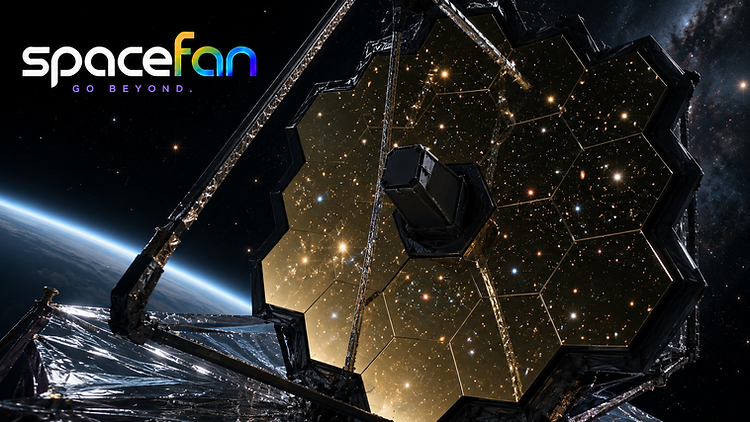
James Webb Space Telescope in space with its gold segmented mirror facing the stars.
Image · Space.Fan

The Drop

Scientists recently took a closer look at a giant called HIP 65426 b. This world is far outside our solar system. To see it, the team used the James Webb Space Telescope, which is the most powerful space telescope we have. By using special tools called coronagraphs, the telescope can block out the bright light of the 's host . This makes it much easier to spot the dim light from the itself. The team updated their computer programs to better process the images and data collected by the telescope. These updates helped them get a much more accurate measurement of how bright the is and exactly where it is located. The new findings show that the is a young, giant world with a cloudy atmosphere. It is also quite hot, with a temperature of about 1,436 degrees Kelvin, or over 2,100 degrees Fahrenheit. While looking at the , the researchers also checked for other objects nearby. They found 21 other points of light, but after careful study, they realized these were just background s or distant galaxies, not other s.
Advertisement

Why It Matters

Getting an accurate look at exos is very difficult because they are small and dim compared to their s. By updating the data analysis for this specific system, researchers are learning how to better use the telescope's tools. This helps them confirm the properties of s more reliably. It also helps them avoid mistakes, like thinking a distant galaxy is a new .
Advertisement

The Catch

One problem the researchers found is that some objects can look like a simple point of light in one camera setting, but look like a large, fuzzy galaxy in another. This makes it hard to be certain what an object is based on only one type of picture. Because of this, astronomers must be very careful when they scan the sky for new s to ensure they are not just looking at a faraway galaxy.

Put That in Perspective

This study acts as a fresh start for measuring this planet. Because the telescope's computer tools have improved, the new measurements for the planet's position and brightness are different from what scientists thought a few years ago. This shows how important it is to keep refining our methods as we learn more about how our technology behaves in space.

Source November 25, 2026
Evelyn L. Bruinsma, Aarynn L. Carter, Sasha Hinkley, Beth A. Biller, Andy Skemer, William O. Balmer, Andrew D. James, Ellis X. Bogat, Ben J. Sutlieff, Michael Poon
Johns Hopkins University, Space Telescope Science Institute, University of Exeter, University of Edinburgh, University of California Santa Cruz, Northwestern University, Laboratoire d’Astrophysique de Marseille, Massachusetts Institute of Technology, University of Toronto·The Astrophysical Journal Letters·10.3847/2041-8213/aebe06

Keep Exploring Space