Space.Fan — Go Beyond
ApJL · 27 MIN AGO
DiscoveriesPEER REVIEWED

Webb Telescope Finds Ancient Tiny Red Dot From Early Universe

By Space.Fan Editorial Desk

Astronomers discovered an incredibly distant, compact galaxy containing a rapidly growing black hole from the very dawn of time.
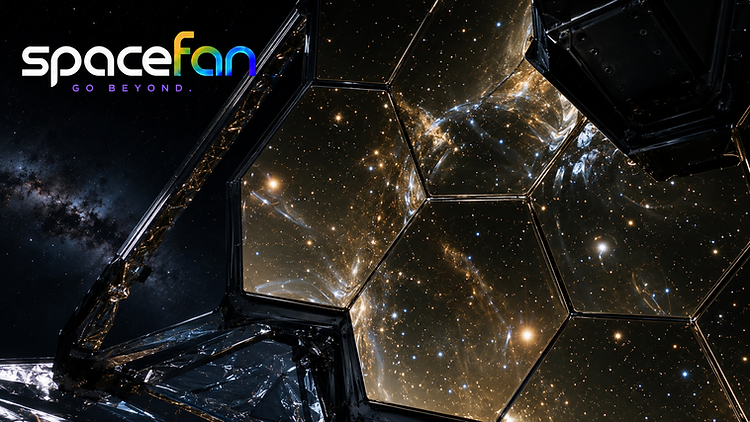
Close-up of the James Webb Space Telescope's gold hexagonal segmented primary mirror in space.
Image · Space.Fan

The Drop

Scientists using the James Webb Space Telescope have spotted a mysterious object nicknamed a Little Red Dot. This object is located very far away, at a record-breaking distance for this specific type of discovery. It appeared when the universe was only a tiny fraction of its current age. The team used a powerful instrument called NIRSpec to capture light from the object, which acted like a chemical fingerprint to reveal its true distance. This bright, compact source shows signs of a supermassive growing at an incredibly high speed. It is the first time researchers have been able to confirm this type of object exists from such a remote period of history. By looking at how the light was stretched and changed as it traveled across space, the team confirmed it is indeed a galaxy housing an active, feeding .
Advertisement

Why It Matters

This discovery is important because it shows that massive s were already growing quickly very early in the history of the universe. Seeing such a well-formed, hungry so soon after the Big Bang challenges our current ideas about how galaxies and s grow together.
Advertisement

The Catch

While the evidence is strong, this object is extremely faint and distant. The team's data includes some signals that are hard to read, meaning more observations are needed to be 100 percent sure about every detail of the 's behavior.

Put That in Perspective

This is a record for the most distant Little Red Dot ever confirmed. Future observations using the telescope's MIRI instrument will help scientists learn more about what this object is truly made of.

Source November 24, 2026
Takumi S. Tanaka, Hollis B. Akins, John D. Silverman, Caitlin M. Casey, Ezequiel Treister, Manuel Aravena, Yuichi Harikane, Benny Trakhtenbrot, Kohei Inayoshi, Kazuhiro Shimasaku
Kavli Institute for the Physics and Mathematics of the Universe, The University of Tokyo, Princeton University, Johns Hopkins University, University of California Santa Barbara, Cosmic Dawn Center, Universidad de Tarapacá, Universidad Diego Portales, Institute for Cosmic Ray Research, Tel Aviv University, Peking University·The Astrophysical Journal Letters·10.3847/2041-8213/aebc8d

Keep Exploring Space