Advertisement
Space.Fan — Go Beyond
ApJL · 27 MIN AGO
UniversePEER REVIEWED

Webb Telescope Sees How a Famous Exploded Star Built Its Own Dust

By Space.Fan Editorial Desk

New data from the James Webb Space Telescope reveals how a massive star blended its materials before it blew up.
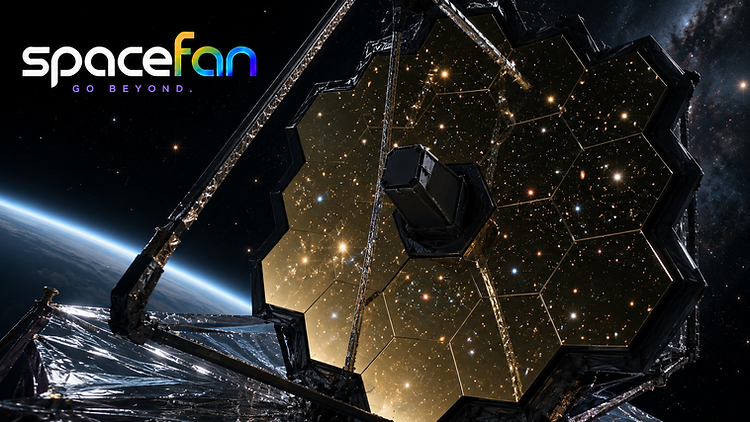
James Webb Space Telescope in space with its gold segmented mirror facing the stars.
Image · Space.Fan

The Drop

Scientists used the James Webb Space Telescope to get a closer look at a famous exploded known as Cassiopeia A. This exploded hundreds of years ago, leaving behind a giant cloud of debris. By using a special camera called the MIRI spectrometer, researchers were able to zoom in on tiny clumps of dust inside this cloud. They discovered that different parts of the cloud are made of different types of dust. Some areas are filled with silica, while others are full of carbon. Being able to see these individual clumps for the first time helps us understand what the was made of before it died. The team compared these findings to computer models of how s explode. They found that the likely went through a process where its inner layers mixed together, specifically its carbon and oxygen shells. This merger happened right before the collapsed and exploded, leaving behind the specific patterns of dust we see today.
Advertisement

Why It Matters

This study is important because it shows us exactly what happens inside a when it nears the end of its life. By mapping the dust, scientists can figure out the chemical recipe of the 's core. This helps prove that some s change their internal structure significantly before they die, which gives us a better picture of how galaxies create the dust needed to form new s.
Advertisement

The Catch

While these findings point toward a shell merger, the results depend on computer models that estimate how s explode. The team has identified the types of dust present, but they are still working to fully explain every chemical detail of the debris. There is always more to learn about the complex physics that occur in the final moments of a 's life.

Put That in Perspective

Cassiopeia A has been studied by many telescopes for decades, but the Webb telescope's ability to see infrared light allows us to peek through thick dust clouds that blocked earlier views. Researchers plan to use these new methods to study other exploded stars in our galaxy to see if they share this same history.

Source November 24, 2026
Tea Temim, Richard G. Arendt, Dan Milisavljevic, Danielle Dickinson, J. Martin Laming, Ilse De Looze, Christopher Fryer, Mikako Matsuura, Salvatore Orlando, Patrick Slane, Nathan Smith, Jeonghee Rho
Columbia University, University of Maryland, Purdue University, Naval Research Laboratory, Ghent University, Los Alamos National Laboratory, Cardiff University, INAF, Harvard & Smithsonian, University of Arizona, SETI Institute·The Astrophysical Journal Letters·10.3847/2041-8213/aea901

Keep Exploring Space