Advertisement
Space.Fan — Go Beyond
ApJS · 19 MIN AGO
UniversePEER REVIEWED

Webb Telescope Helps Clear Up Galactic Fog Around Black Holes

By Space.Fan Editorial Desk

New high-resolution images let scientists peek past messy galaxy light to see the true power of central black holes.
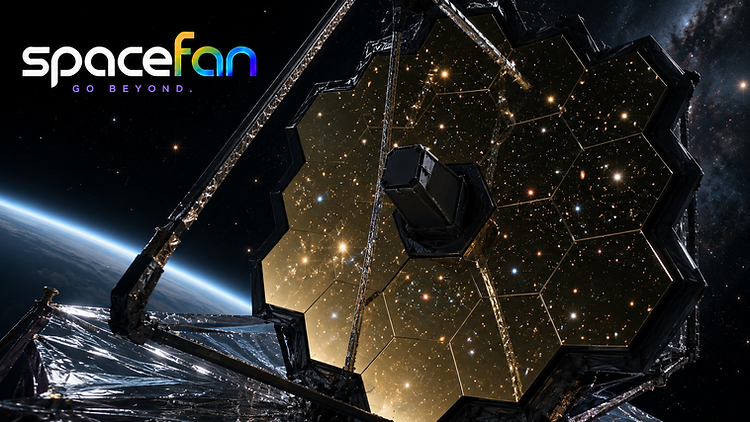
James Webb Space Telescope in space with its gold segmented mirror facing the stars.
Image · Space.Fan

The Drop

Active Galactic Nuclei, or AGNs, are some of the brightest objects in the universe. They are powered by supermassive s at the centers of galaxies, which gobble up nearby gas and dust. As this material falls in, it glows extremely brightly. For years, scientists have struggled to measure exactly how bright these centers are because the light from the surrounding galaxy often gets in the way, acting like a fog that hides the true engine at the core. To solve this, a team of researchers looked at 104 of these objects using a mix of tools, including data from the XMM-Newton and Swift space observatories. These telescopes measure high-energy light that comes directly from the . However, the real game-changer was the James Webb Space Telescope. Its powerful NIRCam instrument provided high-resolution images that allowed the team to distinguish between the light of the central and the light of the host galaxy. By separating these light sources, the researchers were able to create a much clearer picture of the relationship between the 's energy and the dust clouds surrounding it. They found that without the high-resolution power of the Webb telescope, previous measurements were often inaccurate because they included too much extra light from s in the host galaxy.
Advertisement

Why It Matters

Understanding how these s feed and how they interact with their host galaxies is a fundamental piece of the cosmic puzzle. By isolating the true brightness of the central engine, scientists can better understand the physics of how material falls into s and how that process affects the surrounding space. This helps researchers build more accurate models of how galaxies grow and evolve over billions of years.
Advertisement

The Catch

This study is limited to a specific type of galaxy known as Type 1 AGNs, which are viewed from a specific angle that makes their centers easier to see. Because of this, these results may not apply to all types of active galaxies. Additionally, while the Webb data helped reduce the confusion caused by light, scientists still must rely on mathematical models to estimate how much light comes from the versus the galaxy.

Put That in Perspective

In the past, astronomers had to estimate the black hole's output using lower-resolution images, which often led to overestimating the brightness due to the 'fog' of starlight. This new catalog provides a more precise foundation for future space research and sets a new standard for how we measure the most powerful engines in our universe.

Source November 23, 2026
Şeyda Şen, Eda Sonbaş, Ece Kilerci, Hasan Avdan, Kalvir S. Dhuga, Ersin Göğüş, W. N. Brandt
Sabancı University, The George Washington University, İstanbul University, Türkiye National Observatories, The Pennsylvania State University·The Astrophysical Journal Supplement Series·10.3847/1538-4365/aeaffa

Keep Exploring Space