Advertisement
Space.Fan — Go Beyond
AJ · 46 MIN AGO
UniversePEER REVIEWED

A Strange Star System That Exploded Years Ago Is Still Acting Up

By Space.Fan Editorial Desk

Astronomers have discovered that a star system known for a big explosion in 2009 is showing unusual, repeating brightness changes.
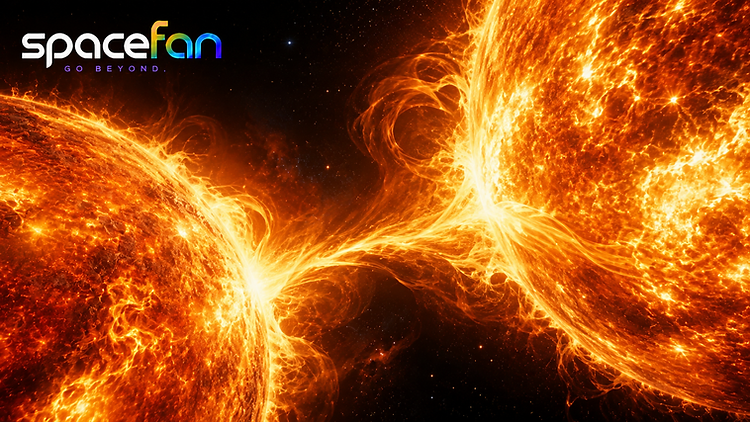
Two fiery stars interacting through huge glowing loops and streams of stellar plasma.

The Drop

In 2009, a system called KT Eridani put on a show when it erupted as a classical nova. This type of event happens when a white dwarf steals enough gas from a neighbor to trigger a massive, bright nuclear explosion. Most of the time, scientists expect things to settle down after such an event, but KT Eridani has been acting differently than expected in the years since. To figure out what was happening, researcher Vojtěch Šimon studied decades of data. He looked at information from the Zwicky Transient Facility, the American Association of Variable Observers, and old photographic plates from Harvard. By tracking how bright the was over time, he could see patterns that did not fit the normal behavior of a post-nova system. Instead of just fading away, the has been going through smaller cycles of brightening and dimming. The data shows that the 's disk—the pool of gas swirling around the white dwarf—is hanging out right on the edge of becoming unstable. These small, repeating flickers of light suggest the is behaving like a different kind of system known as a Z Camelopardalis , which is famous for getting stuck in middle-brightness stages.
Advertisement

Why It Matters

This discovery helps scientists understand the complicated life cycle of binary systems. By watching how these s move between different states of brightness, researchers can learn how gas flows between s and how disks of material behave after a massive eruption. It shows that 'post-nova' s are not just cooling off; they can remain active and go through complex transitions for years.
Advertisement

The Catch

While the patterns look like other known types of active systems, the small size of the brightness changes makes them tricky to study. Because the stays quite bright even when it is not erupting, it is difficult to see the full details of what is happening in the disk. Researchers are using models to interpret the light patterns, but more data is needed to confirm if these mini-outbursts are definitely caused by the same mechanisms seen in other, more typical s.

Put That in Perspective

KT Eridani provides a rare look at how a star system recovers from a major explosion. Future studies will likely focus on watching these small brightness changes to see if they continue to follow the patterns of other cataclysmic variables or if this system has a unique way of managing its energy.

Source November 22, 2026
Vojtěch Šimon
Astronomical Institute of the Czech Academy of Sciences·The Astronomical Journal·10.3847/1538-3881/aeb304

Keep Exploring Space