Advertisement
Space.Fan — Go Beyond
ApJ · 11 HR AGO
UniversePEER REVIEWED

Webb Telescope Reveals How Black Holes Power Up Galaxies

By Space.Fan Editorial Desk

New research shows that active supermassive black holes shape the growth of galaxies during a busy period in the early universe.
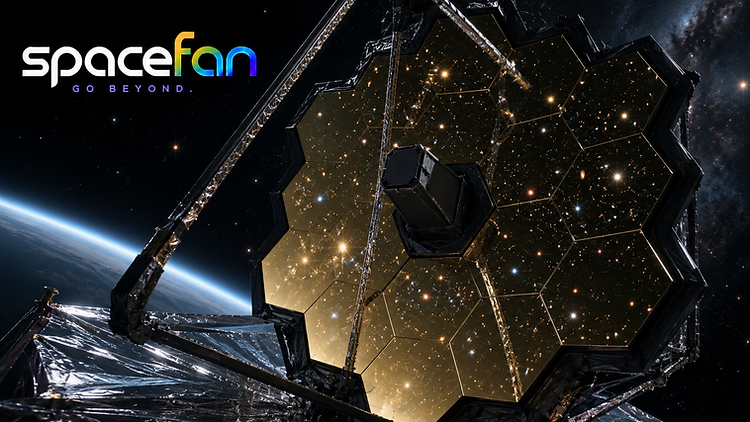
James Webb Space Telescope in space with its gold segmented mirror facing the stars.
Image · Space.Fan

The Drop

Long ago, when the universe was only a few billion years old, galaxies were going through a major growth spurt. Scientists call this time Cosmic Noon. During this period, s were forming rapidly, and many galaxies held supermassive s at their centers that were actively gobbling up gas. These active centers, called Active Galactic Nuclei or AGN, release huge amounts of energy that push outward into the galaxy. Researchers used the James Webb Space Telescope to look closely at about 200 of these distant galaxies. They wanted to see how this energy changed the gas inside the galaxies. To do this, they used a special camera on the telescope to map out glowing gas, specifically tracking light from oxygen and hydrogen. They discovered that galaxies with active s had much larger areas of glowing, energized gas than normal galaxies. By comparing these active galaxies to quieter ones, the team found that the s were definitely responsible for lighting up and pushing around gas across wide distances. It shows that these centers play a massive role in changing a galaxy's environment. This study is important because it shows exactly how much influence a central has compared to the energy created by new s. While young s also add energy to a galaxy, the active s act like engines that can stretch their influence far out into the galaxy's gas clouds. This process is a key part of how galaxies evolve over billions of years.
Advertisement

Why It Matters

Understanding this relationship helps scientists map out the history of how galaxies reach their final shapes. It proves that supermassive s are not just passive residents, but active managers that influence the raw material needed to make new s.
Advertisement

The Catch

While the data is very strong, the researchers note that formation also contributes to the glow of the gas. Separating exactly how much energy comes from a versus from clusters of hot, young s is difficult, so there is still some mixing in the results.

Put That in Perspective

In the past, telescopes could not see these small details from such a great distance. Webb's sharp vision allows astronomers to compare these early galaxies to ones closer to us, showing that the rules of how black holes affect their homes have stayed mostly consistent over cosmic time.

Source September 24, 2026
Sophie Lebowitz, Kevin N. Hainline, Stéphanie Juneau, Christina C. Williams, Swayamtrupta Panda, Jianwei Lyu, Michael V. Maseda, Sandro Tacchella, Yongda Zhu, Jessica L. Aguayo
Steward Observatory, University of Arizona, NSF NOIRLab, International Gemini Observatory, University of Wisconsin–Madison, Kavli Institute for Cosmology·The Astrophysical Journal·10.3847/1538-4357/ae984b

Keep Exploring Space