Advertisement
Space.Fan — Go Beyond
ApJ · 2 HR AGO
UniverseMODEL

Why Computer Models of Black Holes Are Sometimes Wrong

By Space.Fan Editorial Desk

Scientists found that some black hole simulations contain errors that don't reflect how stars are actually destroyed.
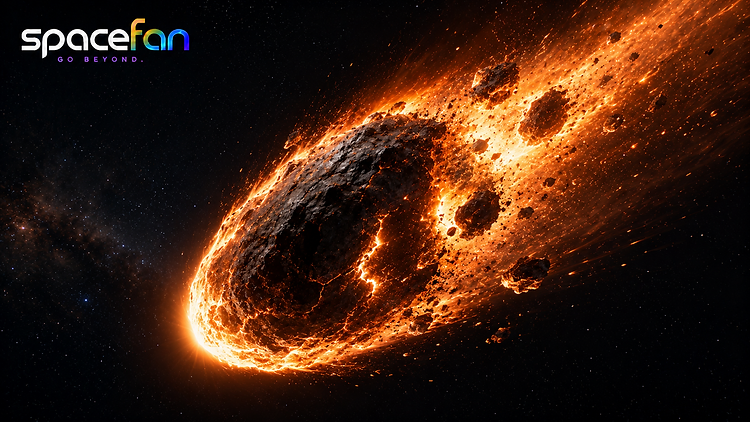
Large fractured asteroid engulfed in flames and glowing debris as it travels through space.
Image · Space.Fan

The Drop

When a giant gets too close to a , its gravity can rip the apart. This event is called a tidal disruption event. For a long time, experts thought that the pieces of the destroyed would crash into each other to form a bright, spinning disk of gas. This crash was supposed to be the main reason the debris slows down and settles around the . However, some computer programs that try to recreate this event have been showing something strange. The programs show the material acting weirdly and spreading out even before the pieces hit each other. This looked like a fake, ghost-like explosion happening inside the simulation. Researchers decided to investigate why this was happening. They discovered that the problem was actually with the math inside the computers. The software struggles to handle how the gas changes speed and direction as it whips around the . Because of how the computer processes this motion, it creates an artificial error that looks like a real physical event. By looking at the math and how the programs are written, the team showed that this 'fanning out' of debris is a computer glitch rather than a real thing that happens in space. This helps fix a long-standing mystery about why simulations and observations didn't always match up.
Advertisement

Why It Matters

This discovery is important because it changes how we interpret data from space telescopes. If scientists rely on simulations that contain these math errors, they might draw the wrong conclusions about how s feed on s. By identifying that these glitches are caused by the software's rules, experts can now update their programs to be more accurate. Correcting these models helps us better understand how much light a produces when it eats a . This lets astronomers more accurately map the life cycles of galaxies and the powerful energy these s release into space.
Advertisement

The Catch

This research explains why computer models show certain errors, but it does not mean we have solved everything about how s are destroyed. The scientists focused specifically on why the simulations show this 'fake' energy, but they still need to create new, better software tools to fully map out how the debris behaves in the real universe.

Put That in Perspective

Astronomers have been trying to solve the mystery of what happens to a shredded star for decades. These findings suggest that for years, we have been looking at 'artifacts' of computer code rather than real cosmic behavior. Future studies will likely focus on creating better simulation tools that can handle the complex movement of gas without creating these errors.

Source November 23, 2026
C. J. Nixon, Eric R. Coughlin, and Zachary L. Andalman
University of Leeds, Syracuse University, and Princeton University·The Astrophysical Journal·10.3847/1538-4357/aeaa55

Keep Exploring Space