Advertisement
Space.Fan — Go Beyond
AJ · 8 DAYS AGO
DiscoveriesNEW OBSERVATION

A Giant Space Gas Cloud Is Building New Stars in the M33 Galaxy

By Space.Fan Editorial Desk

Scientists have found a massive, long string of gas in the nearby M33 galaxy that is acting like a nursery for baby stars.
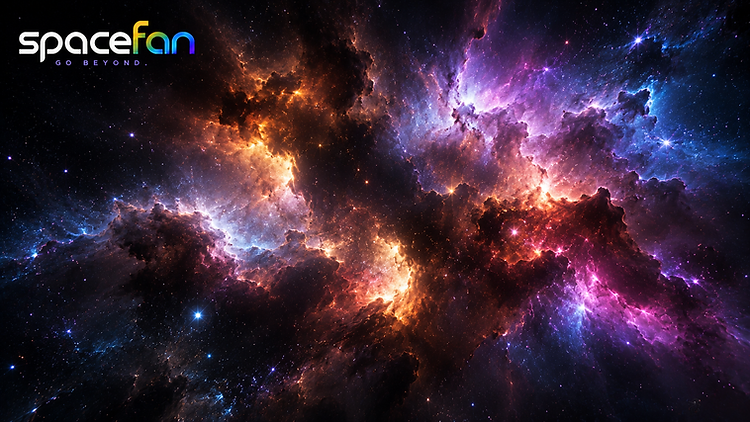
Colorful glowing nebula filled with stars and clouds of blue, purple, orange, and red gas.
Image · Space.Fan

The Drop

Astronomers have discovered a giant, rope-like structure made of gas inside the M33 galaxy. This structure is very long and stretches across a huge distance in space. It is a dense, cold cloud where gravity is working to squeeze gas together to create brand new s. By looking closely at this area, researchers were able to see the exact locations where s are beginning to form. To see this clearly, the team used the NOEMA telescope array. This is a very powerful group of radio telescopes that can look through thick dust clouds to see the cold gas hidden inside. It allowed them to map the area in great detail, almost like taking a high-definition photograph of a place trillions of miles away. The team noticed that the -forming gas is arranged in a line with bright spots. They also saw that hot, young s are appearing nearby. This shows a clear path of how the galaxy takes cold, messy gas and turns it into organized, shining s. It is like watching a factory line where raw materials are turned into finished products. This discovery confirms that formation in this galaxy follows a specific pattern. The gas gets squeezed into tight shapes, which then triggers the birth of new s. Because we can see the gas and the new s side-by-side, it helps prove exactly how these cosmic structures function.
Advertisement

Why It Matters

Understanding how gas turns into s is one of the biggest puzzles in astronomy. This study is important because it shows a very clear link between the shape of gas clouds and the birth of s. By watching this process in the center of M33, scientists can test their theories about how galaxies grow and change over time. This confirms that gravity acts in predictable ways even in very distant parts of our local neighborhood of galaxies. It helps researchers move away from guessing how nurseries work and provides actual, high-resolution evidence that they can use to build better maps of our universe.
Advertisement

The Catch

While the researchers found a clear pattern, they still do not fully know what is pushing the gas to compress in the first place. The study does not tell us exactly what role the galaxy's spiral shape or rotation plays in this process. Scientists have not yet ruled out other outside forces that might be nudging the gas into these dense, -making shapes.

Put That in Perspective

Scientists have studied galaxies for a long time, but new tools like NOEMA allow us to see much finer details than ever before. In the past, we could only see these clouds as blurry shapes. Now, we can see structures just a few light-years across. Future research will likely focus on mapping more of these filaments to see if they are common in every galaxy.

Source November 14, 2026
AJ

Keep Exploring Space