Advertisement
Space.Fan — Go Beyond
ApJS · 48 MIN AGO
MissionsPEER REVIEWED

A New Math Tool to Spot Strange Things in Deep Space

By Space.Fan Editorial Desk

Scientists created a new way to help the Vera C. Rubin Observatory quickly find and identify unusual objects in our night sky.
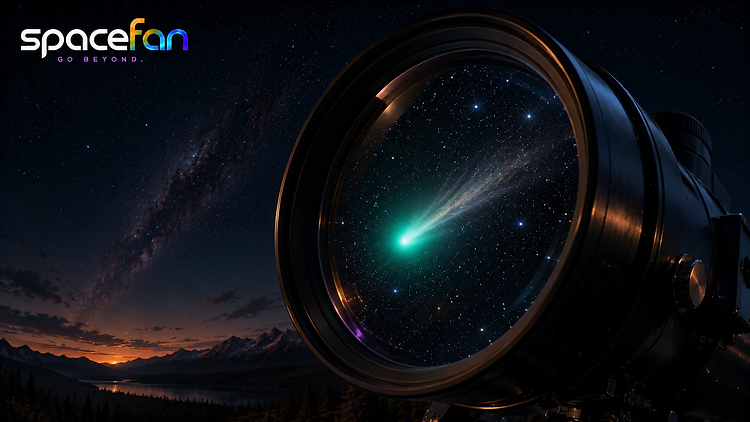
Large telescope lens reflecting a bright green comet beneath the Milky Way above a mountain landscape at dusk.
Image · Space.Fan

The Drop

The upcoming Vera C. Rubin Observatory is going to take pictures of the entire visible sky over and over again. This will create a massive amount of data, making it hard for astronomers to keep track of every single change. To solve this, researchers developed a new mathematical tool that uses information theory to sort through what the telescope sees. Think of it like a smart filter that helps computers decide which space objects are common and which ones are truly special. This method acts like a language translator for space data. It measures how much new information a specific object gives us. If an object is already well-known, like a standard flickering , the math tells the computer that it is not very exciting. But if an object shows a pattern we have never seen before, the math highlights it as a potential discovery. This helps researchers quickly decide which space events are worth a closer look by other telescopes. The team tested this approach to see if it could help organize thousands of different space signals. By using this cross-entropy metric, they can better classify moving or changing objects in real time. It is a vital step in preparing for the observatory to begin its work, ensuring that no strange or unique cosmic event is missed in the flood of incoming information.
Advertisement

Why It Matters

This tool is a big deal because the sheer amount of data from the new observatory would be impossible for humans to watch manually. By automating the search for oddities, scientists can save time and energy. It allows them to focus their limited follow-up resources on the most important and scientifically interesting events, rather than wasting time on things we already understand well.
Advertisement

The Catch

While this tool is great at finding differences, it relies on how well we already know the 'standard' objects. If a brand-new type of cosmic event looks very similar to something we have already cataloged, the math might accidentally label it as boring. The effectiveness of this system depends on the accuracy of the computer models used to train it.

Put That in Perspective

Astronomers have always struggled to keep up with the changing sky, from early stargazers sketching constellations to modern digital cameras. This new method is the next step in that evolution, moving from human observation to high-speed, automated data science that can keep up with the fastest cameras on Earth.

Source November 22, 2026
Yu-Qian (Rachel) Ouyang, Alex I. Malz, Ming Lian, Shar Daniels, Mathilda Nilsson, Federica B. Bianco
University of Chicago, Space Telescope Science Institute, University of Delaware, Lehigh University·The Astrophysical Journal Supplement Series·10.3847/1538-4365/aeafff

Keep Exploring Space