Advertisement
Space.Fan — Go Beyond
ApJS · 15 HR AGO
DiscoveriesMODEL

A New Way to Clear Up Blurry Pictures of Deep Space

By Space.Fan Editorial Desk

Scientists have found a better way to fix blurry radio telescope images of giant space clouds.
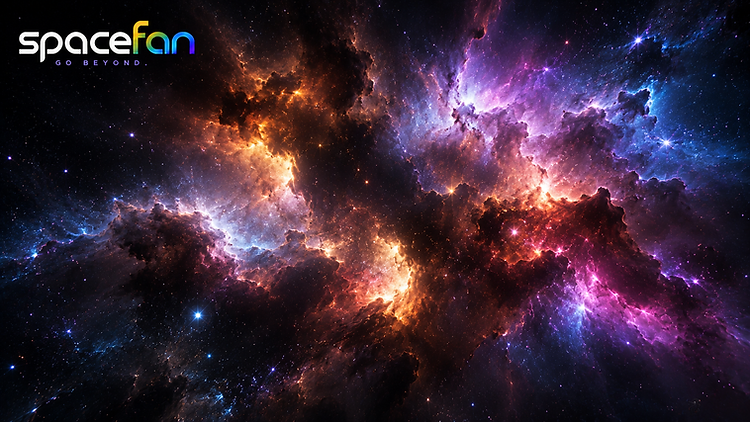
Colorful glowing nebula filled with stars and clouds of blue, purple, orange, and red gas.
Image · Space.Fan

The Drop

Radio telescopes like ALMA are amazing tools that help us see hidden parts of space. However, they sometimes struggle to take clear pictures of very large, spread-out clouds of gas. Because of the way these telescopes are built, they often miss the 'big picture'—they see small details well, but the wide, fuzzy edges of gas clouds seem to disappear from the final image. This makes it hard for scientists to know exactly how much gas is really there or how s are forming. To fix this, researchers created a new mathematical method called Constrained Diffusion Decomposition, or CDD for short. This method acts like a special filter that breaks down an image into different layers. By separating the sharp parts of the image from the fuzzy parts, the team can use math to predict exactly what the missing, spread-out gas should look like. They tested this idea by looking at computer-made simulations of the Perseus molecular cloud. Instead of spending weeks running heavy computer programs to guess what the image should show, this new tool can estimate the result much faster. It uses a specific math formula to fill in the gaps that the telescope hardware naturally leaves behind. This helps astronomers get a much clearer, more accurate map of the sky without needing to perform complicated experiments every time they take a picture.
Advertisement

Why It Matters

This discovery matters because it bridges the gap between what telescopes actually see and what is really happening in space. Astronomers use computer models of gas clouds to understand how s grow, but these models are often hard to compare to real data because real telescope images have those blurry, missing parts. By using this new method, researchers can now compare their theories directly to real images with much more confidence. It helps them measure the amount of gas in -forming regions more accurately, which is a key part of learning how galaxies evolve.
Advertisement

The Catch

This method is a mathematical model, not a direct observation. It relies on how well we understand the way the telescope filters light. While it is very good at predicting what is missing, it cannot 'see' new details that were never captured by the telescope in the first place. If the telescope misses too much data, the math can only make an educated guess based on the patterns it expects to see, which might not be perfect for every single cloud in the sky.

Put That in Perspective

In the past, scientists had to run massive, slow computer simulations to guess what their telescopes were missing. This new tool makes the process much more direct and easier to handle. Next, researchers will likely test this on even more types of space clouds to see how well it works on different shapes and sizes of gas.

Source September 27, 2026
ApJS

Keep Exploring Space