Advertisement
Space.Fan — Go Beyond
ApJ · 5 HR AGO
UniversePEER REVIEWED

Astronomers Find Ancient Stars That Hold Secrets of the Early Universe

By Space.Fan Editorial Desk

Scientists discovered ten very old, metal-poor stars that reveal how the first stars in our universe lived and died.

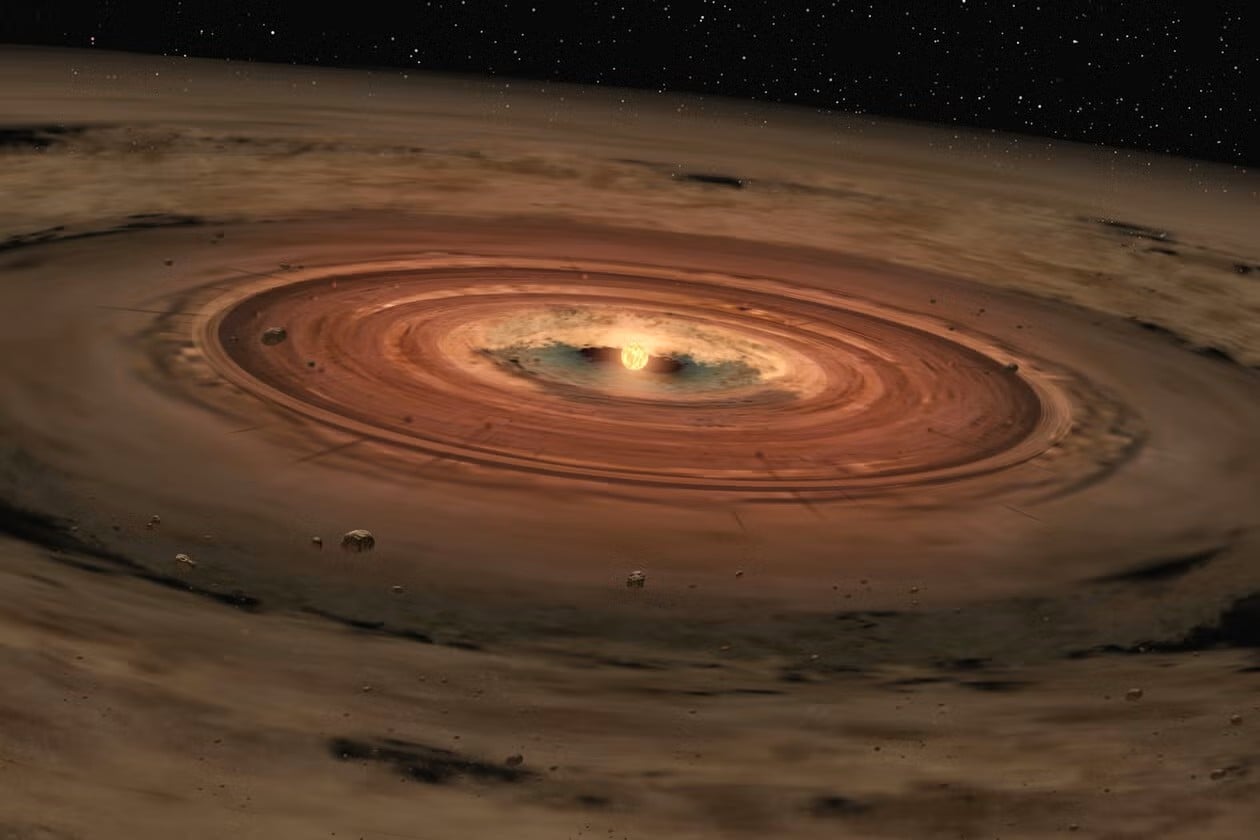
A colorful nebula with a planet and moon in the foreground.
Image · Space.Fan

The Drop

Astronomers have found ten incredibly old s that are nearly as ancient as the universe itself. These s are special because they are extremely metal-poor, meaning they contain very few elements heavier than hydrogen and helium. These elements usually get mixed into space after s explode, so finding s with so little of them is like finding a time capsule from the very beginning of the cosmos. To study these distant s, researchers used the powerful Magellan telescope located in Chile to capture detailed light signatures called spectra. By looking at these patterns of light, the team could measure exactly how much strontium and barium each contained. The scientists found that these s were born from gas that had been touched by only a few early explosions. This allows researchers to trace exactly what kind of materials were scattered by the very first generations of s.
Advertisement

Why It Matters

This discovery helps us learn how the first s in the universe behaved. Because these s were created so early, their chemical makeup acts as a footprint of the explosions that came before them. By measuring these elements, scientists can test their theories about how the building blocks of the universe were first formed. It confirms that these early, small s were shaped by a very small number of massive, exploding s that lived and died shortly after the Big Bang.
Advertisement

The Catch

While these s provide a great look into the past, the results are based on models that estimate how much material was produced by those ancient explosions. Because we cannot directly observe those first s, scientists must make approximations. There is a small margin of error in these calculations, meaning the exact amount of chemical material spread by those first s could vary slightly from what the team predicts.

Put That in Perspective

Scientists plan to use these findings to improve how they write computer simulations of the early universe. This data acts as a guide for future studies, helping researchers understand how the chemical variety we see today began with just a few tiny, ancient stars.

Source September 28, 2026
Sarah Hughes, Anna Frebel, Xiaowei Ou, Alexander Yelland, Felicia Xiao, Jorian Benke, Kali Kraus, Reidyn Wingate, Mohammad K. Mardini
Massachusetts Institute of Technology, University of Virginia·The Astrophysical Journal·10.3847/1538-4357/ae9aff

Keep Exploring Space