Advertisement
Space.Fan — Go Beyond
ApJ · 41 MIN AGO
Sun & Space WeatherPEER REVIEWED

A New Way to Predict Solar Storms in Real Time

By Space.Fan Editorial Desk

Scientists have created a smart computer program that can map the Sun’s magnetic energy to help us forecast dangerous solar storms faster than ever.
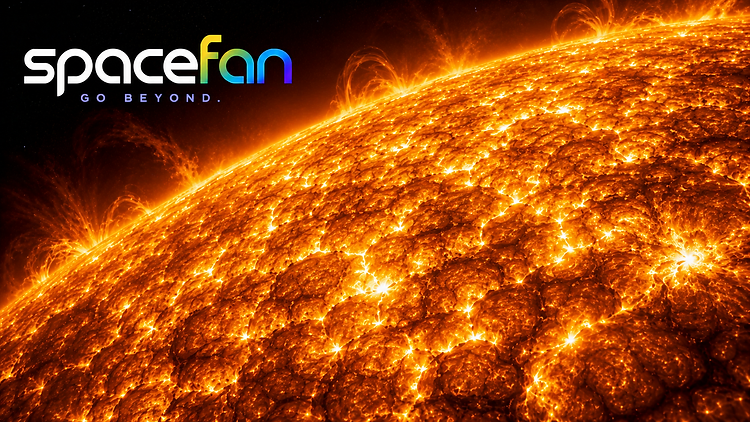
Close-up of the fiery Sun showing bright active regions and looping plasma above its surface.
Image · Space.Fan

The Drop

Our Sun is a busy and active . Sometimes it releases giant bursts of energy called solar flares or coronal mass ejections. These events can send invisible waves of magnetic energy toward Earth. If these waves hit us, they can interfere with our satellites, GPS signals, and even power grids. Because of this, space scientists want to be able to predict these storms before they happen. To do this, they need to see how magnetic fields on the Sun are twisted and building up pressure. Mapping these 3D magnetic fields usually takes a long time, making it too slow to act as an early warning system. A team of researchers has now solved this by using a special type of artificial intelligence called a 3D U-Net. Instead of doing complex math for every point, this AI learned how to predict the shape of the magnetic field from simpler data. It works much faster, allowing scientists to see the Sun’s magnetic activity in real time. The team tested their program on past records of solar activity, and it proved to be very accurate at showing how energy builds up and eventually snaps during a major flare.
Advertisement

Why It Matters

This technology changes how we monitor space weather by cutting down the time it takes to get an accurate map of the Sun's magnetic field. By knowing exactly when and where energy is building up on the solar surface, experts can better predict if a coming solar storm will be large enough to cause problems for our technology here on Earth.

Aurora Tonight

Live NOAA outlook

Fair aurora activity

Best odds in Alaska, northern Canada, and far-northern Europe

Aurora activity36%
Peak Kp tonight: 4NOAA nowcast max: 16%Source: NOAA SWPC

Aurora forecasts are probabilistic. Darkness, clouds, local light pollution, and rapidly changing solar-wind conditions affect what you can actually see.

Advertisement

The Catch

While this tool is much faster than older methods, it is still a model that relies on what it was taught. It uses data from past solar events to make its predictions. This means it might struggle to accurately map brand-new types of magnetic activity that the computer has never seen before.

Put That in Perspective

In the past, detailed 3D modeling was like trying to draw a complex map by hand while the landscape was constantly changing. Now, this AI tool acts more like a fast camera, capturing the shape of the magnetic field almost instantly. Researchers will likely use this tool to create better long-term space weather alert systems.

Source November 23, 2026
Fengping Dou, Xiaoshuai Zhu, Dong Zhao, Zhongrui Zhao, Yihua Yan
National Space Science Center, Chinese Academy of Sciences, Beihang University·The Astrophysical Journal·10.3847/1538-4357/aeb7dc

Keep Exploring Space