Advertisement
Space.Fan — Go Beyond
PSJ · 2 HR AGO
Solar SystemPEER REVIEWED

Moon Craters Are Shallower in Its Darkest Corners

By Space.Fan Editorial Desk

New high-resolution images show that small craters in the Moon's cold, shadowed regions are shaped differently than those in sunny areas.
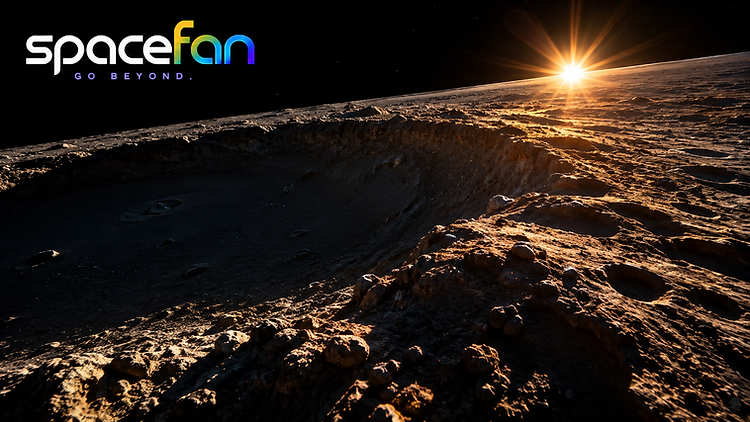
A lunar crater on the surface of the Moon.

The Drop

The is covered in millions of tiny impact craters. These craters are created when space rocks strike the lunar surface. For a long time, scientists have studied how these holes form to understand what the 's ground is made of. Most of these craters look like deep bowls with steep sides. However, new data from a powerful camera called ShadowCam shows something different at the lunar poles. ShadowCam takes very clear pictures of the 's permanently shadowed regions. These are deep craters and spots that never see direct sunlight. Because it is so cold in these areas, scientists think that water ice and other frozen gases might be mixed into the dirt, known as regolith. By creating 3D maps from these images, researchers compared craters in shadowed areas to those in areas that get plenty of sun. They discovered that the craters in the dark, cold spots are systematically shallower. This means they are not as deep as similar-sized craters found near the 's equator. This difference suggests that the ground inside these dark regions is special. The researchers believe that the ice hidden in the dirt makes the ground behave differently when something hits it, or perhaps causes the craters to wear down and fill in much faster than they would in warmer parts of the .
Advertisement

Why It Matters

Understanding why these craters are shallower is a big deal for future lunar missions. If the shape of a crater is influenced by ice hidden in the ground, scientists can use these crater shapes like a map to find where water might be trapped. Finding water on the is important because it could be used for drinking or making rocket fuel by future astronauts. This discovery also helps us understand the history of the lunar surface. By comparing craters in different environments, experts can better learn how the 's ground changes over millions of years. It proves that even small craters hold big secrets about the ingredients found in the soil.
Advertisement

The Catch

While the results are clear, the researchers still have questions about exactly why these craters are shallower. They have a few ideas, such as the ground being softer due to ice or a faster process of erosion, but they cannot be 100% sure yet without landing a spacecraft to test the soil directly. The findings are based on digital maps, so they depend on how well those maps reflect the true, bumpy surface of the .

Put That in Perspective

Before ShadowCam, it was very hard to see inside the dark areas of the Moon because they never receive light. Now that we have high-resolution data, scientists can start to look at other regions to see if this pattern holds up everywhere the sun does not reach.

Source November 22, 2026
A. J. Sonke, P. Mahanti, J. K. Ando, B. W. Denevi, S. Li, M. S. Robinson
Intuitive Machines, University of Hawai'i at Mānoa, Johns Hopkins University Applied Physics Laboratory·The Planetary Science Journal·10.3847/PSJ/aeb4ad

Keep Exploring Space