Advertisement
Space.Fan — Go Beyond
ApJL · 26 MIN AGO
Asteroids & CometsPEER REVIEWED

A Visitor From Far Away Is Made of Different Stuff Than Our Comets

By Space.Fan Editorial Desk

Scientists used the Webb telescope to analyze a space traveler, discovering it is built from materials unlike those in our own solar system.
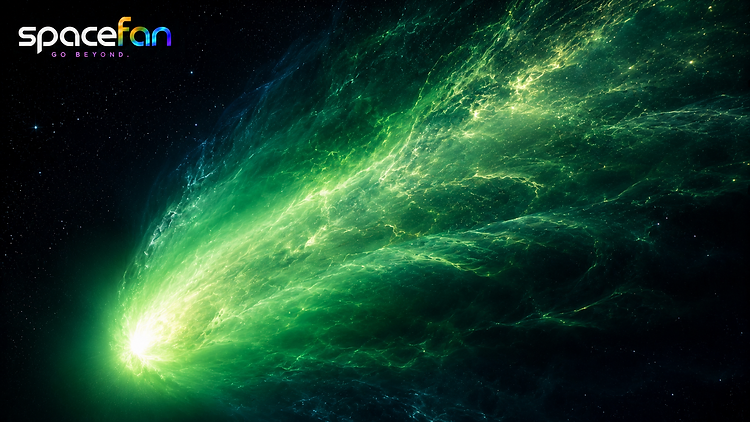
Brilliant green comet with a huge turbulent emerald plasma tail streaming across deep space.
Image · Space.Fan

The Drop

Astronomers have taken a close look at a rare visitor from another system called 3I/ATLAS. This object is an interstellar traveler, meaning it came from somewhere far beyond our sun. Using the James Webb Space Telescope, researchers studied the dust trailing behind the object like a 's tail. They looked at light coming from this dust to figure out exactly what minerals were inside it. This special light, known as an infrared spectrum, acts like a chemical fingerprint that tells us the composition of the object without us ever having to touch it. The results show that 3I/ATLAS is made mostly of a type of dust called amorphous silicates. This is a big deal because these materials have not been organized into the neat, orderly crystal shapes we usually find in the s born here in our solar system. Instead, the dust looks much more like the raw, disorganized material found floating in the deep space between s.
Advertisement

Why It Matters

This discovery helps us learn how other solar systems are put together. If 3I/ATLAS formed in a very distant part of its home system, it might have been made from materials that never got close enough to a to be heated up and turned into crystals. This tells us that the way s and s form can be very different across the galaxy. It suggests that our own solar system's habit of mixing hot, crystalline materials into s might be a unique trait rather than a universal rule.
Advertisement

The Catch

There is a small chance that the object was once made of crystals, but they were broken down over millions of years of traveling through harsh space. While the researchers think this is unlikely because the object looks so different from our own s, they cannot rule it out completely. Scientists also need more data on other interstellar objects to know if this one is a typical example or just an oddity.

Put That in Perspective

In the past, we could only guess what these visitors were made of based on their brightness. With the James Webb Space Telescope, we can now break down the light to see individual ingredients. Future studies will likely compare this object to more interstellar travelers to see if we can find a pattern in how they are built.

Source September 28, 2026
ApJL

Keep Exploring Space