Advertisement
Space.Fan — Go Beyond
arXiv · 4 DAYS AGO
UniverseMODEL

Are Early Galaxies Hiding Black Holes or Just Misunderstood?

By Space.Fan Editorial Desk

New models suggest that young galaxies from the dawn of time might not need giant black holes to explain their bright, glowing light.
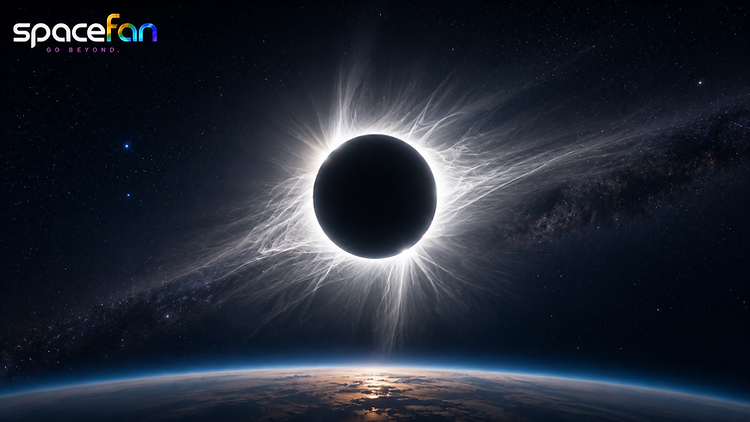
Total solar eclipse with a brilliant white corona suspended above the curved horizon of Earth viewed from space.
Image · Space.Fan

The Drop

Astronomers have been busy using the James Webb Space Telescope to study some of the very first galaxies to form in the universe. When they look at these ancient light-filled objects, they see bright signals that usually suggest a massive —known as an AGN—is hiding at the center, eating gas and glowing brightly. However, these new findings suggest that we might be jumping to conclusions too quickly. Researchers took a closer look at eight of these early galaxies using the telescope's powerful NIRSpec instrument. They measured the light emitted by different gases inside these systems, such as carbon, oxygen, and helium. They found that these ancient galaxies have special conditions, including very low levels of heavy elements and high gas density, that were different from what we see in galaxies today. The team created advanced computer simulations to see if these unique, natural conditions could explain the bright light signals without needing a . They discovered that when they adjusted their models to match the environment of these early galaxies, the light signals changed. The results showed that -forming regions can mimic the exact light signatures that astronomers previously thought only came from giant s. This means that simply seeing those specific light signals is not enough proof to say a is present. The galaxy's own young, metal-poor s and dense gas clouds could be responsible for the glow all on their own.
Advertisement

Why It Matters

This discovery is important because it changes how we count s in the early universe. If we mistake a bright galaxy for a , our census of how many s existed shortly after the Big Bang could be completely wrong. By correcting our tools for reading galaxy light, we can get a much more accurate picture of how the first structures in our universe grew and evolved over billions of years.
Advertisement

The Catch

While the new models successfully explain most of the light signals, they are not perfect. Some light signatures, specifically very strong helium lines, still do not fit the models perfectly. This means there is still a mystery left to solve regarding exactly what is happening in the hearts of these distant, ancient galaxies.

Put That in Perspective

Scientists are now looking at how to update their diagnostic tools so they can better account for the unique conditions found in the very first galaxies. Future research will likely focus on these lingering mysterious signals to see if they reveal new physics or just require even more detailed modeling of early galaxy chemistry.

Source November 19, 2026
Jiayang Yang, Casey Papovich, Weida Hu, Taylor A. Hutchison, Rebecca L. Larson, Pablo Arrabal Haro, Anthony J. Taylor, Ray Garner III, Kaila Ronayne, Nikko J. Cleri, Steven L. Finkelstein, Bren E. Backhaus, Micaela B. Bagley, Justin W. Cole, Jeyhan S. Kartaltepe
·10.48550/arXiv.2611.23391

Keep Exploring Space