Advertisement
Space.Fan — Go Beyond
ApJ · 2 DAYS AGO
UniverseMODEL

Cosmic Ray 'Waves' Could Reveal Hidden Space Turbulence

By Space.Fan Editorial Desk

New research shows how tiny ripples in space plasma could help us map the invisible movement of high-energy particles.
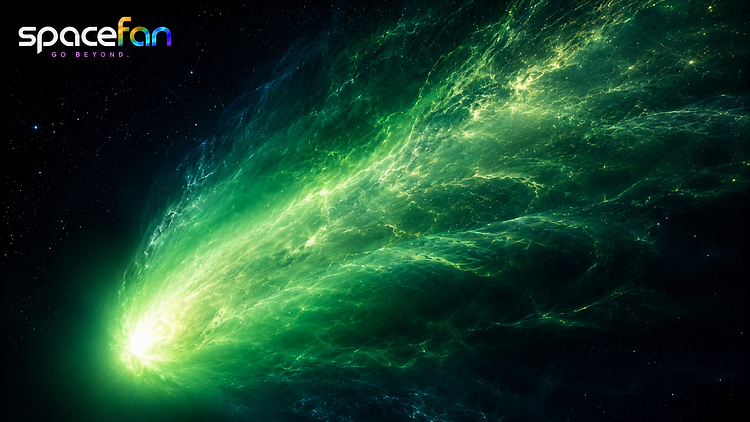
Brilliant green comet with a huge turbulent emerald plasma tail streaming across deep space.
Image · Space.Fan

The Drop

Space is not truly empty. It is filled with a thin gas called plasma that acts like a fluid. Floating through this gas are cosmic rays, which are tiny particles traveling at nearly the speed of light. When this plasma moves in messy, swirling patterns—a process called turbulence—it can push and pull on these cosmic rays, causing them to move in wavy patterns. Scientists call these patterns convective oscillations. Researchers Yiran Zhang and Siming Liu developed a new mathematical model to describe how these particle waves behave. By studying the math behind how plasma swirls, they found that these vibrations leave a specific footprint. This footprint appears as a power-law, which is a way of measuring how the energy of these waves is distributed across different sizes of space. To understand this, imagine dropping a rock into a pond. The ripples that spread out tell you about the water and how hard you threw the rock. In space, the turbulence is like the water, and the cosmic rays are like the ripples. By looking at these specific patterns in the data, astronomers can work backward to figure out what the invisible gas in deep space is doing.
Advertisement

Why It Matters

This research provides a new tool for studying the distant universe. Pulsars, which are dead s that spin very fast, create large glows of gamma-ray light around them. Because these glows are influenced by the surrounding gas and magnetic fields, being able to read these patterns acts like a telescope for invisible energy. It allows scientists to probe the chaotic environment of interstellar space, which is usually impossible to see directly.
Advertisement

The Catch

This study is based on a mathematical model and not a direct observation of a specific pulsar. The results rely on the assumption that the cosmic ray distribution follows a standard Gaussian shape. If the actual conditions in space are more complex or different than this simplified model assumes, the predictions might not perfectly match what telescopes see in the future.

Put That in Perspective

Astronomers have known for a long time that cosmic rays travel through space in a zigzag path because of magnetic fields. Now, they are looking to future high-resolution images of pulsar gamma-ray halos to test this theory. If the images show the specific wave patterns predicted by the researchers, it will confirm that we finally understand how the 'weather' of deep space moves.

Source November 21, 2026
Yiran Zhang and Siming Liu
Southwest Jiaotong University·The Astrophysical Journal·10.3847/1538-4357/aeb546

Keep Exploring Space