Advertisement
Space.Fan — Go Beyond
DiscoveriesPEER REVIEWED

Early Galaxies Were Messier Than We Thought

By Space.Fan Editorial Desk

New observations show that some of the first galaxies in the universe were already blowing out heavy elements into space.
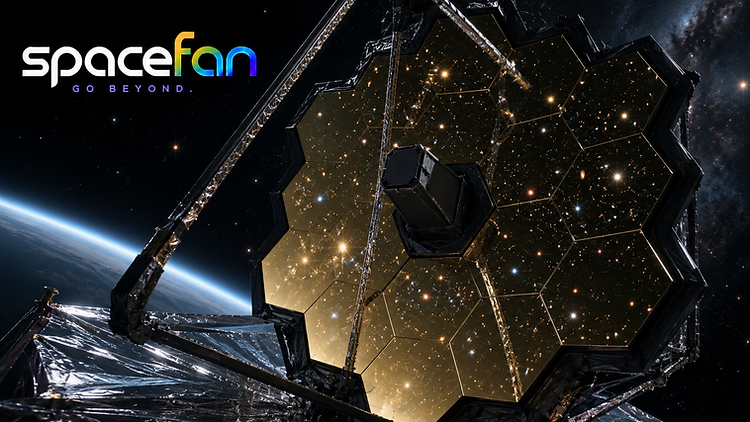
James Webb Space Telescope in space with its gold segmented mirror facing the stars.
Image · Space.Fan

The Drop

Scientists have found that early galaxies were busy cleaning house much sooner than expected. By looking at light from galaxies that existed when the universe was only a few hundred million years old, researchers discovered clouds of metal-enriched gas surrounding them. This means these young systems were already pushing heavy elements like oxygen and carbon out into the space around them. To make this discovery, the team used the James Webb Space Telescope. They used a special instrument called NIRSpec, which acts like a prism to split light into a spectrum. By looking at these light patterns, they could see the 'fingerprints' of different atoms in the gas. The way this light shifted told the researchers that the gas was moving, likely being pushed away by the energy of new, bright s. This process is called a baryon cycle. It is the way galaxies recycle gas to grow, change, and fuel new s. Previously, scientists were not sure if this kind of active recycling happened so early in the history of the cosmos. These new results prove that some galaxies were already operating in this complex way very shortly after the Big Bang.
Advertisement

Why It Matters

This discovery matters because it changes our understanding of how galaxies grow up. Before this, we thought it might take a long time for galaxies to build up enough heavy elements to blow them out into their surroundings. Seeing this happen so early shows us that the engines of formation were working at full power much faster than some models predicted.
Advertisement

The Catch

While this is an exciting finding, the researchers only looked at a small group of three galaxies. It is not yet clear if all early galaxies behaved this way, or if these three were just special, unusually active examples. More observations of other early galaxies are needed to know if this was a common trend across the early universe.

Put That in Perspective

Astronomers have been using the James Webb Space Telescope to peer deeper into time than ever before. While we have known for a while that the very first stars were forming early on, this study confirms that those stars immediately started changing their environment. Researchers will likely look for more of these gas 'fountains' in other distant galaxies to see how widespread this behavior truly was.

Source September 24, 2026
Yongda Zhu, Zhiyuan Ji, George D. Becker, Jiani Ding, Eiichi Egami, Xiaohui Fan, Xiangyu Jin, Weizhe Liu, Jianwei Lyu, Zheng Ma, Suprabhas Narisetty, George H. Rieke, Yunjing Wu, Minghao Yue, Junyu Zhang, Marcia J. Rieke
University of Arizona·Nature Astronomy

Keep Exploring Space