Advertisement
Space.Fan — Go Beyond
arXiv · 3 HR AGO
UniverseEARLY RESEARCH

Early Galaxies Were Spinning Like Modern Ones

By Space.Fan Editorial Desk

A new study reveals that giant galaxies in the young universe were already rotating in an organized way.
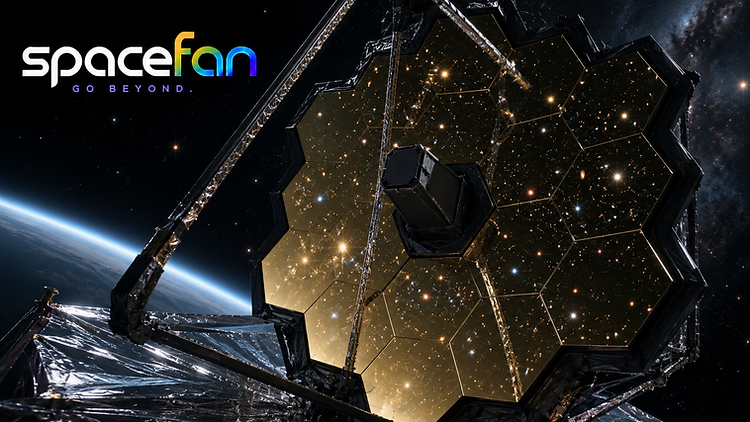
James Webb Space Telescope in space with its gold segmented mirror facing the stars.
Image · Space.Fan

The Drop

Astronomers have taken a close look at 16 massive, -filled galaxies from when the universe was very young. These galaxies come from a time only about 1.5 billion years after the Big Bang. Scientists used a massive survey called TRICEPS to study how gas and dust move inside these distant objects. By looking at these galaxies in great detail, researchers were able to see the motions of gas within them with incredible precision. They found that even at this early stage, these galaxies were not just messy clumps of s. Instead, they were organized systems that spun in a regular, rotating way. This is similar to how many large, mature galaxies look in our own local corner of the universe today. To get this look, the team used the ALMA telescope array to track cold gas and dust, along with the James Webb Space Telescope to see where s were forming. This combination of tools allowed them to map the anatomy of these ancient galaxies at a very small scale, making it the largest study of its kind for this time period in cosmic history.
Advertisement

Why It Matters

This discovery changes our understanding of how galaxies grow. It shows that galaxies could settle into orderly, spinning shapes much faster than some scientists previously thought. It tells us that the early universe was capable of creating large, organized structures very quickly after the Big Bang.
Advertisement

The Catch

While these galaxies were mostly rotating in a regular way, some were clearly being disturbed by nearby neighbors. About half of the galaxies in the study were found in pairs, and some showed signs of crashing into each other. This means that while early galaxies could be orderly, they were also prone to chaotic, violent interactions as they collided and changed shape.

Put That in Perspective

Scientists have spent years wondering if galaxies had to take a long time to become the flat, spinning disks we see today. This new evidence suggests that the basic architecture of a galaxy can appear quite early in time, even when the universe was in its infancy.

Source September 28, 2026
Federico Lelli, Lingrui Lin, Zhi-Yu Zhang, Cecilia Bacchini, Davide Bevacqua, Joe Bhangal, Marco Castellano, Carlos De Breuck, Giovanni Gandolfi, Allison W. S. Man, Antonino Marasco, Diego Paris, Borja Pérez-Díaz, Paola Santini
·10.48550/arXiv.2609.30375

Keep Exploring Space