Advertisement
Space.Fan — Go Beyond
Universe Today · 5 HR AGO
UniversePEER REVIEWED

Euclid Space Telescope Finds Oldest Known Quasar

By Space.Fan Editorial Desk

A massive black hole discovered in the early universe is breaking records for how fast it formed after the Big Bang.
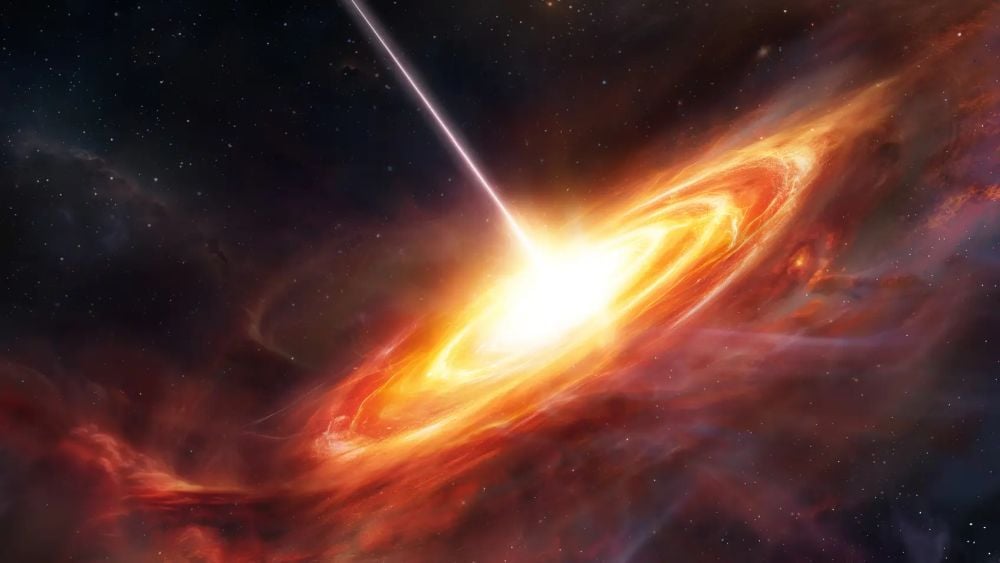
A small red dot representing the distant quasar Dún Aonghasa seen against a dark background of space in a Euclid survey image.
Image · Universe Today

The Drop

Astronomers have discovered a record-breaking quasar named Dún Aonghasa. A quasar is a super bright light powered by a giant that is swallowing huge amounts of nearby space matter. This new discovery is special because of how old it is. It existed just 630 million years after the Big Bang, which is about 40 million years older than the previous record holder. This means we are seeing this object as it appeared when the universe was only a tiny fraction of its current age. The Euclid Space Telescope first spotted this light while looking at a wide patch of the sky. Because Euclid is designed to study how the universe expands, it captures vast amounts of data that help scientists find rare, ancient objects like this one. After Euclid made the initial find, researchers used other powerful tools like the James Webb Space Telescope and the Keck Observatory to confirm exactly what it was. By using these different telescopes, they were able to measure its distance and determine that the inside this quasar has a mass 360 million times greater than our own Sun.
Advertisement

Why It Matters

Finding such a large so early in the history of the universe is a major puzzle for scientists. Current theories about how s grow suggest that they should take a long time to get this big. When we find something so massive existing so shortly after the universe began, it forces experts to rethink their ideas about how quickly these objects can form and gain mass. Every new, distant discovery like this helps astronomers narrow down exactly how the very first galaxies and s were built.
Advertisement

The Catch

While this discovery is exciting, scientists still have many questions about how a could grow this quickly in the early universe. The data tells us the mass and distance, but it does not tell us the exact process that allowed it to get so big in such a short amount of time. It is possible that our current models of how matter falls into s are missing an important piece of the puzzle.

Put That in Perspective

To understand the scale, 39 million years might sound like a long time, but in the life of the universe, it represents only about 6% of the time that had passed since the Big Bang when this object existed. Researchers will likely continue to use telescopes like the James Webb and Euclid to hunt for even older objects to see if this quasar is a rare oddity or part of a common trend in the ancient cosmos.

Source November 25, 2026
Julien Wolf
Max Planck Institute for Astronomy·Astronomy and Astrophysics

Keep Exploring Space