Advertisement
Space.Fan — Go Beyond
ApJ · 5 DAYS AGO
Sun & Space WeatherMODEL

How Earth's Magnetic Shield Protects Our Air from Escaping to Space

By Space.Fan Editorial Desk

Scientists used a powerful computer model to find out how Earth loses oxygen when its magnetic shield gets weak.
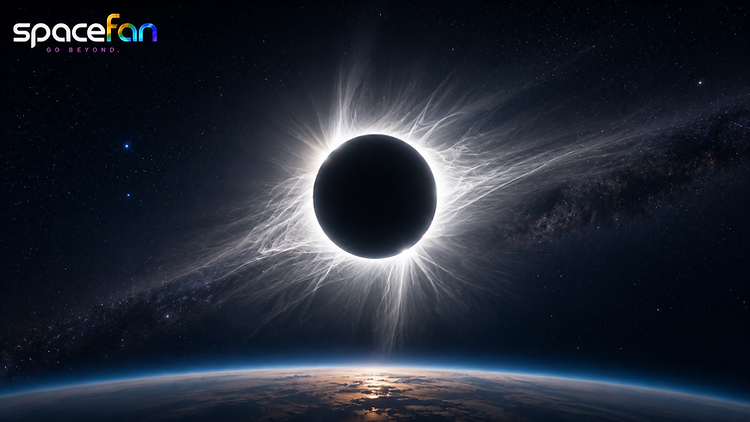
Total solar eclipse with a brilliant white corona suspended above the curved horizon of Earth viewed from space.
Image · Space.Fan

The Drop

Earth is protected by a magnetic field that acts like a giant shield. This shield helps keep our air, including the oxygen we breathe, trapped near the surface. But scientists have long wondered what happens to that air if the magnetic field gets weaker over time, or if the poles shift. Using a complex computer program, researchers created a 3D model to see how oxygen ions, which are charged oxygen particles, leak away into space. The model tracks how these particles behave under different strengths of Earth's magnetic shield. The results show that the strength of this magnetic shield is the most important factor in keeping our air safe. When the shield is strong, it holds onto the oxygen well. However, when the field becomes very weak, the amount of oxygen leaking into space grows rapidly. If the magnetic field drops to just a small fraction of what it is today, the loss of oxygen could skyrocket to massive levels. The study also looked at how the tilt of the magnetic field affects this process. While the shield's total strength is the main gatekeeper, the angle of the tilt acts like a secondary switch, changing how much of our atmosphere is exposed to the harsh solar wind coming from the Sun. This process is most dangerous during times when the magnetic poles are flipping, as that is when the magnetic field is at its weakest.
Advertisement

Why It Matters

This research is important because it helps us understand the history of Earth's atmosphere and what might happen in the distant future. By knowing how much air the can lose during magnetic shifts, scientists can better guess how ancient Earth managed to keep its air for billions of years. It helps paint a clearer picture of how a 's magnetic shield is vital for supporting life over long periods of time.
Advertisement

The Catch

This study relies entirely on a computer model rather than direct observations of the ancient past. While the math is rigorous, real-world conditions can be much more complex than what a simulation can account for. The results show what could happen based on our current understanding, but these scenarios are projections that represent theoretical possibilities rather than historical records.

Put That in Perspective

Scientists are looking to test these results against data from other planets that have weaker magnetic fields. By comparing Earth's potential for loss with other worlds, they hope to refine their models to better predict how magnetic fields influence a planet's ability to remain habitable as it ages.

Source November 17, 2026
Ming Wang, Jinyu Li, Lianghai Xie, Jianyong Lu, Guanchun Wei, Kehan Du, Yikai Yuan, Kai Zhao, Liuguan Ding, Lei Li
Nanjing University of Information Science and Technology, National Space Science Center, Chinese Academy of Sciences·The Astrophysical Journal·10.3847/1538-4357/aeb6ab

Keep Exploring Space