Advertisement
Space.Fan — Go Beyond
ApJ · 45 MIN AGO
UniverseSIMULATION

How Turbulent Gas Helps Hungry Black Holes Stay Fed

By Space.Fan Editorial Desk

New simulations show that messy, swirling gas in space acts like a conveyor belt to keep supermassive black holes active and growing.
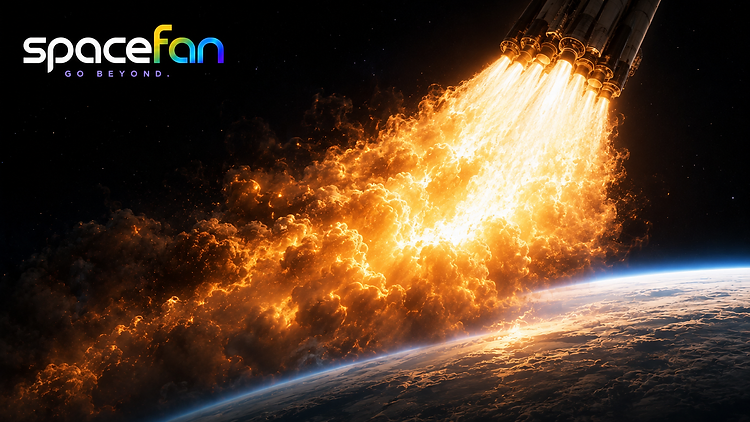
Rocket ascending above Earth with a bright orange exhaust plume.
Image · Space.Fan

The Drop

Supermassive s sit at the center of most galaxies. These giants often launch powerful jets of energy into space, but scientists have long wondered how these s keep finding enough fuel to keep those jets running. Using advanced computer simulations, researchers studied how the gas around a behaves when it is moving in chaotic, swirling patterns called turbulence. In a calm, still environment, a 's own energy can accidentally push away all the cold gas it needs for dinner, causing the jets to shut down. The team found that when the gas is turbulent, it creates a messy mix of hot and cold material. This churning motion moves the gas around, allowing the to constantly pull in new fuel. The researchers used 'turbulent box' simulations to track these interactions. They discovered that turbulence acts as a bridge, carrying away the hot, empty bubbles created by the 's energy and bringing fresh, cold gas back toward the center. This process acts like an automatic feeding system, preventing the from ving.
Advertisement

Why It Matters

This research explains a major mystery in galaxy evolution: why some s stay active for a long time instead of turning off. By proving that turbulence is necessary for keeping a fed, scientists can better predict how galaxies grow and change over billions of years. It shifts our understanding from thinking of gas as a simple background ingredient to seeing it as a dynamic, moving structure that controls the power of the most massive objects in the sky.
Advertisement

The Catch

These findings come from idealized computer simulations, which are simplified models of reality. While they show how turbulence works in theory, real galaxies are much more complicated with complex magnetic fields and many different types of particles. Scientists still need to compare these digital results with actual telescope observations to see if the real universe follows these exact same rules.

Put That in Perspective

Astronomers have long struggled to connect what happens right near a black hole to the much larger scales of a whole galaxy. By showing that local turbulence in the gas determines how far and how strong these jets spread, researchers have found a way to bridge the gap between small-scale feeding habits and galaxy-wide effects. Future studies will likely test how different types of galaxy environments change this feeding process.

Source November 24, 2026
Olga Borodina, Jake S. Bennett, Yueying Ni, Rainer Weinberger, Michaela Hirschmann, Boon Kiat Oh, Lars Hernquist
Center for Astrophysics Harvard & Smithsonian, University of Michigan, Leibniz-Institut fur Astrophysik Potsdam, Ecole Polytechnique Federale de Lausanne, Korea Institute for Advanced Study·The Astrophysical Journal·10.3847/1538-4357/aebc61

Keep Exploring Space