Advertisement
Space.Fan — Go Beyond
ApJ · 45 MIN AGO
Sun & Space WeatherPEER REVIEWED

Space Telescope Sees Our Solar System’s Edge React to Solar Storms

By Space.Fan Editorial Desk

Scientists used a specialized space probe to watch how massive solar explosions change the outer boundary of our solar system for the first time.
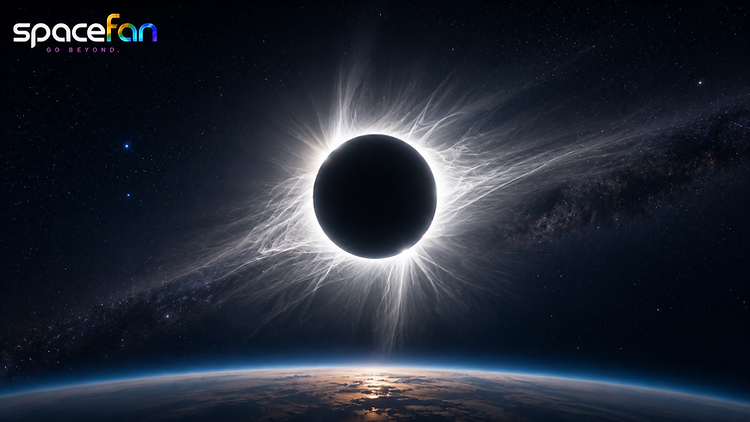
Total solar eclipse with a brilliant white corona suspended above the curved horizon of Earth viewed from space.
Image · Space.Fan

The Drop

Our solar system has an outer shell called the heliosphere. This boundary protects us from harsh space rays. For years, scientists believed that giant explosions on the sun, known as coronal mass ejections, could travel all the way to this edge and push against it. However, catching this in action has been extremely difficult until now. A research team used NASA’s Interstellar Boundary Explorer, or IBEX, to look for proof of these distant impacts. IBEX works by counting neutral atoms that bounce back from the very edge of the solar system. By studying data collected between 2012 and 2013, the team discovered that solar storms occurring in quick succession clumped together to form massive waves. When these waves slammed into the heliosheath, the region at the edge of our solar system, they caused a spike in pressure. This pressure surge triggered a clear increase in the number of neutral atoms detected by the spacecraft. This is the first time we have seen a direct link between specific solar events and changes in the far reaches of our solar system.
Advertisement

Why It Matters

This discovery gives scientists a new way to monitor the outer solar system from a great distance. Previously, we only knew about these distant changes from Voyager probes, which are actually flying through that region. Being able to see these impacts remotely means we can study the entire edge of our solar system at once rather than just a single point in space. It confirms that the sun's activity has a much larger reach than we previously could prove, helping us understand how our solar system interacts with the interstellar space beyond.

Aurora Tonight

Live NOAA outlook

Slight aurora activity

Mostly Arctic: Alaska, northern Canada, Greenland, and far-northern Europe

Aurora activity28%
Peak Kp tonight: 3NOAA nowcast max: 17%Source: NOAA SWPC

Aurora forecasts are probabilistic. Darkness, clouds, local light pollution, and rapidly changing solar-wind conditions affect what you can actually see.

Advertisement

The Catch

While this study shows a clear link, it relies on complex data collected over a decade ago. The process of turning detected atoms into a map of the solar system's edge involves many calculations and computer models. Because this is a new method of remote sensing, researchers must still be careful to ensure that the detected changes in atoms are caused specifically by the solar waves and not by other background space activity.

Put That in Perspective

In the past, we had to wait for a physical probe like Voyager to travel across the vast distance to the heliosheath to measure it. Now, by using IBEX to watch for these pressure waves, we can study the outer boundary in a global way. Scientists are expected to use these new methods to see how the heliosphere responds to different types of solar activity over longer periods of time.

Source November 24, 2026
Nehpreet K. Walia, Daniel B. Reisenfeld, David J. McComas, Herbert O. Funsten, Sung Jun Noh, Eric J. Zirnstein, Lengying Khoo, Manuel E. Cuesta, Fan Guo, Richa N. Jain, Paul H. Janzen, Thomas K. Kim, George Livadiotis, Jamie S. Rankin, Mitchell M. Shen, Jeongbhin Seo
Princeton University, Los Alamos National Laboratory, New Mexico Consortium, Chungbuk National University, University of Alabama in Huntsville, University of Montana·The Astrophysical Journal·10.3847/1538-4357/aeb1aa

Keep Exploring Space