Advertisement
Space.Fan — Go Beyond
ApJ · 5 DAYS AGO
DiscoveriesPEER REVIEWED

James Webb Telescope Reveals How Stars Grow in Nearby Galaxy

By Space.Fan Editorial Desk

New deep-space images show a hidden 'star factory' where stars are being born one after another like a cosmic chain reaction.
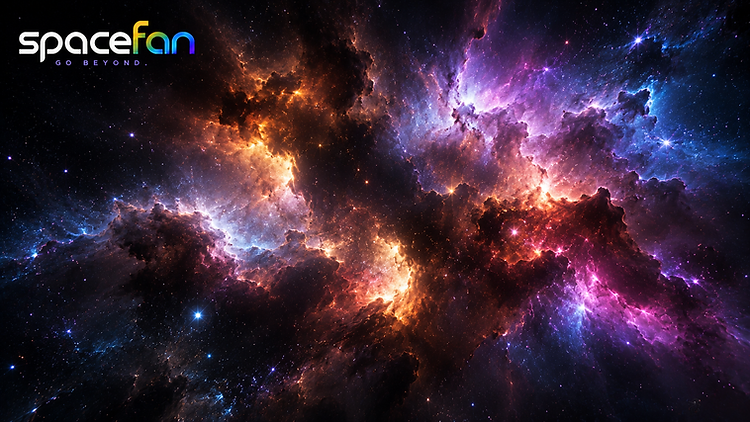
Colorful glowing nebula filled with stars and clouds of blue, purple, orange, and red gas.
Image · Space.Fan

The Drop

Astronomers using the James Webb Space Telescope have taken a closer look at a giant cloud of gas and dust called N159. This region is located in a neighbor of our own galaxy, known as the Large Magellanic Cloud. It is a massive area, stretching over 130 s across. For years, scientists have wondered how so many s form in one place. By using the telescope's powerful infrared cameras, researchers looked through the thick clouds that usually hide young s from our view. They counted over 300,000 tiny points of light, including s that are very small and just beginning to glow. Some of these baby s are less than 500,000 years old, which is very young in the life of a . By studying the colors of these s, the team found that the -forming process is happening in a specific order across the region. Some areas are slightly older, while others are full of brand-new s still wrapped in their birth clouds of gas and dust.
Advertisement

Why It Matters

This research confirms a theory called sequential formation. It suggests that when a large forms, it pushes against the surrounding gas, which then causes more s to form nearby. Think of it like a ripple in a pond that triggers more waves. Seeing this happen in such detail helps scientists understand how galaxies build s over time and what causes large clouds of gas to eventually turn into new systems.
Advertisement

The Catch

While the data is clear, the study only shows us a snapshot in time. We cannot watch a single go through its whole life cycle because s take millions of years to grow. Scientists have to look at different s at different stages of development to guess how the whole process works. There is always a chance that some of the very faint objects spotted are further away or closer than they appear, which could change our understanding of their exact age or mass.

Put That in Perspective

N159 has been a target for telescopes for decades, but the James Webb Space Telescope’s ability to see through thick dust allows us to count stars that were previously invisible. Researchers will likely use this data to build better computer models of how gas clouds collapse to form solar systems similar to our own.

Source November 17, 2026
Nolan Habel, E. Sabbi, Peter Zeidler, Tuila Ziliotto, Laurie Chu, Margaret Meixner, Guido De Marchi, O. C. Jones, Alec S. Hirschauer, Beena Meena, Jeroen Jaspers, Laura Lenkić, Rémy Indebetouw
Jet Propulsion Laboratory, California Institute of Technology, NSF NOIRLab, Space Telescope Science Institute, European Space Agency, UK Astronomy Technology Centre, Morgan State University, National Radio Astronomy Observatory, Maynooth University, Dublin Institute for Advanced Studies, University of Virginia·The Astrophysical Journal·10.3847/1538-4357/aeb2fc

Keep Exploring Space