Advertisement
Space.Fan — Go Beyond
ApJ · 2 HR AGO
UniversePEER REVIEWED

Webb Telescope Reveals How Dust and Stars Shape the Whirlpool Galaxy

By Space.Fan Editorial Desk

New observations show how tiny dust particles and giant star nurseries build the structure of the famous Whirlpool Galaxy.
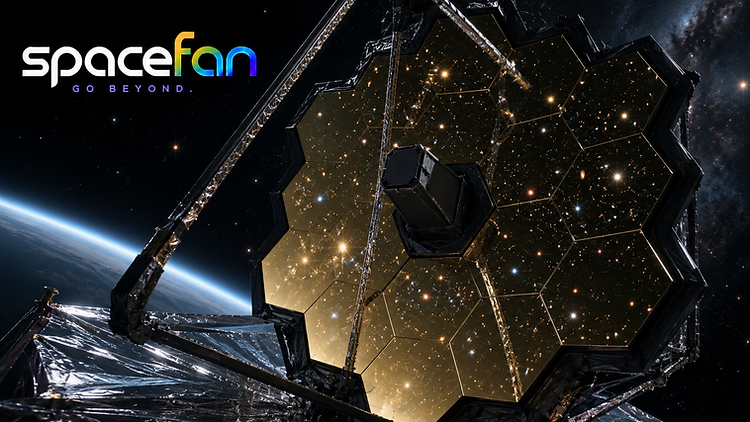
James Webb Space Telescope in space with its gold segmented mirror facing the stars.
Image · Space.Fan

The Drop

Astronomers have used the James Webb Space Telescope to look deep into the heart of the Whirlpool Galaxy, also known as M51. By using the telescope's MIRI instrument, scientists captured detailed images in eight different light filters. This allows researchers to see things that are normally hidden behind thick clouds of space dust. By studying these images, the team was able to map out where gas is hiding and where brand-new s are being born. The researchers focused on specific light patterns called polycyclic aromatic hydrocarbons, or PAHs. Think of these as tiny soot-like particles floating through space. By comparing these particles to other types of light that trace different gases, the team discovered that these dust particles act like a perfect partner for the cold gas in the galaxy. They move and sit right alongside the clouds that eventually turn into s. However, the team noticed that the relationship changes when a ts to shine brightly. When s are very hot and active, they release a lot of energy that can actually destroy these tiny dust particles. By breaking down the light into its different parts, the researchers could separate the regions of the galaxy where gas is simply hanging out from the areas where intense birth is actively happening.
Advertisement

Why It Matters

This discovery helps us understand the life cycle of galaxies. By knowing exactly how dust is connected to gas and new s, scientists can better predict how galaxies grow and evolve over billions of years. It confirms that space dust is a key ingredient in building s and reveals how harsh radiation from newborn s can change the landscape of their home galaxy.
Advertisement

The Catch

While the data is very clear, the study is mostly focused on regions where there is a lot of molecular gas. It is possible that in other, emptier parts of space or in different types of galaxies, these patterns might not look exactly the same. The researchers also used models to separate the light, which relies on our current understanding of how light interacts with dust.

Put That in Perspective

The Whirlpool Galaxy has been a favorite target for telescopes for decades, but Webb provides a level of detail that was previously impossible. By seeing the galaxy in mid-infrared light at a scale of about 40 light-years, scientists are getting a clear look at the building blocks of star systems. Future studies will likely look at how these findings apply to more distant galaxies across the universe.

Source September 25, 2026
ApJ

Keep Exploring Space