
Advertisement
Space.Fan — Go Beyond
ApJL · 3 DAYS AGO
Sun & Space WeatherPEER REVIEWED

Magnetic Fields Are Shaping the Solar Surface in Unexpected Ways

By Space.Fan Editorial Desk

New research shows that magnetic fields in the Sun's atmosphere are causing particles to move in patterns we did not expect.
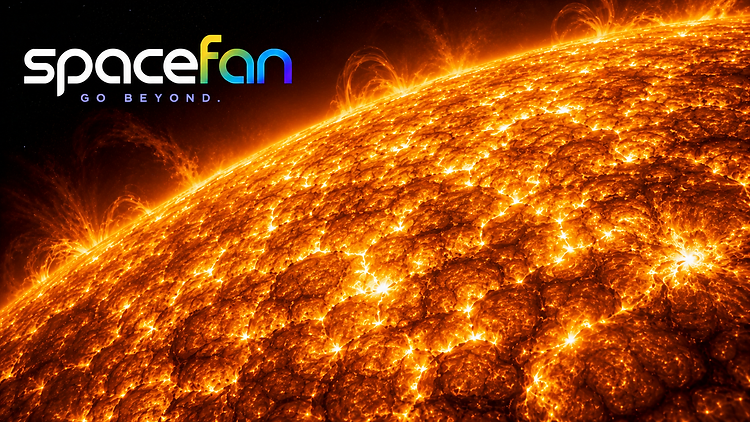
Close-up of the fiery Sun showing bright active regions and looping plasma above its surface.
Image · Space.Fan

The Drop

The Sun's atmosphere is a busy and energetic place. Scientists have known for a long time that there is a special layer called the transition region where things get very hot very quickly. For years, they noticed that light signals coming from this area looked a bit messy or spread out, but they were not sure why this was happening or how common it was across the entire Sun. To get a better look, researchers used the Interface Region Imaging Spectrograph, or IRIS. This tool acts like a powerful camera that breaks down light to see how particles are moving. By studying a large set of pictures covering the whole Sun, the team found that about 60 percent of the particles were not behaving the way standard science models predicted. Instead of following typical motion patterns, these particles were showing special signatures that suggest they are moving at very high speeds. The most interesting part is that this behavior seems to change based on how the Sun's magnetic field is pointing. When the magnetic field lines cross the view of the camera, the particles show these strange speed signatures much more often. This proves that the magnetic field is not just a background feature; it is actually steering how particles move and how energy is released in the Sun's atmosphere.
Advertisement

Why It Matters

This discovery matters because it helps us correct our models of the Sun. For a long time, scientists used basic physics models that treated the Sun's atmosphere like a smooth fluid. This new data proves that we need more detailed models that account for individual particle behavior, often called kinetic processes. By understanding how the magnetic field pushes particles around, researchers can better predict how energy flows on the Sun, which is crucial for understanding how the solar atmosphere stays so hot.
Advertisement

The Catch

While this study identifies a clear link between magnetic fields and particle movement, it is still a complex puzzle. The researchers note that these signals are seen from the perspective of our telescopes, meaning the way we view the Sun's light can be affected by the angle of the magnetic field. More advanced computer simulations will be needed to fully confirm if these patterns are caused by specific magnetic energy releases, such as reconnection, or if there are other hidden factors at play.

Put That in Perspective

Scientists have been puzzled by the 'excess broadening' of solar light for years. This study moves the conversation forward by showing that these messy signals are not just random noise, but a structured result of magnetic geometry. Future studies will likely focus on creating new mathematical models that finally match what we are seeing in these high-resolution images.

Source September 21, 2026
ApJL

Keep Exploring Space