Advertisement
Space.Fan — Go Beyond
ApJL · 3 HR AGO
UniversePEER REVIEWED

Mapping the Invisible Gas That Feeds Young Galaxies

By Space.Fan Editorial Desk

Researchers have created a new map of neutral hydrogen in the early universe, revealing more large, gas-rich galaxies than we previously thought.
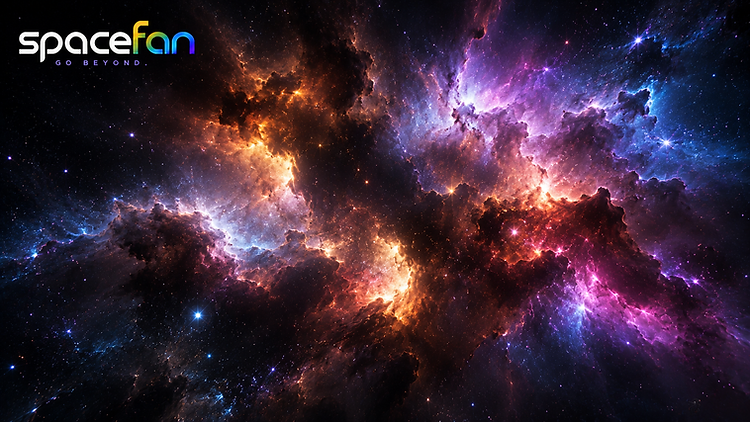
Colorful glowing nebula filled with stars and clouds of blue, purple, orange, and red gas.
Image · Space.Fan

The Drop

Neutral hydrogen is the raw material that galaxies use to build s. For a long time, scientists have wanted to know how much of this gas existed in the universe about 8 billion years ago. To find out, a team of researchers combined data from two major radio telescopes: the uGMRT in India and the CHIME telescope in Canada. These tools listen for a very faint signal emitted by hydrogen atoms in space. Because direct observation of such distant, faint gas is extremely difficult, the team used a clever mathematical trick. They built a computer simulation of the universe and placed 'dark matter' halos into it. Dark matter is the invisible stuff that acts like a scaffolding for galaxies. The researchers then used an advanced statistical method to see how much hydrogen gas would need to be attached to those halos to match the real signals they picked up from the telescopes. The results show that most of the universe's neutral hydrogen is locked up in galaxies of a specific size. Surprisingly, the team found that there are more 'heavyweight' galaxies—those with lots of hydrogen—than older computer models had predicted. This suggests that the way galaxies grow and hoard their fuel might be more active than we once believed.
Advertisement

Why It Matters

This discovery helps us write a better 'life story' for galaxies. By understanding how hydrogen is spread out across space, scientists can better track how galaxies form s over billions of years. If there is more gas in large galaxies than we thought, it means those galaxies had more 'food' to create new s during the middle age of the universe.
Advertisement

The Catch

This research relies on a computer model to fill in the gaps where our telescope data is not perfectly clear. The result is a best-fit estimate based on the information we currently have. While it is a strong improvement, it remains a model-based prediction that will need to be checked against even more sensitive observations as new radio telescopes come online in the future.

Put That in Perspective

Earlier studies often struggled to see the full picture of how gas was distributed in the distant past. By combining the strengths of different radio observatories and applying new statistical techniques, this study provides a clearer benchmark for future research into galaxy growth.

Source September 30, 2026
Minal Chhabra, Raghunath Ghara, Somnath Bharadwaj
Department of Physics, Indian Institute of Technology Kharagpur·The Astrophysical Journal Letters·10.3847/2041-8213/aea790

Keep Exploring Space