Advertisement
Space.Fan — Go Beyond
ApJ · 6 DAYS AGO
UniverseMODEL

New AI Tool Sharpens Our View of Hidden Space Lenses

By Space.Fan Editorial Desk

Scientists have created a powerful new computer model to see how giant galaxies bend light from the distant universe.
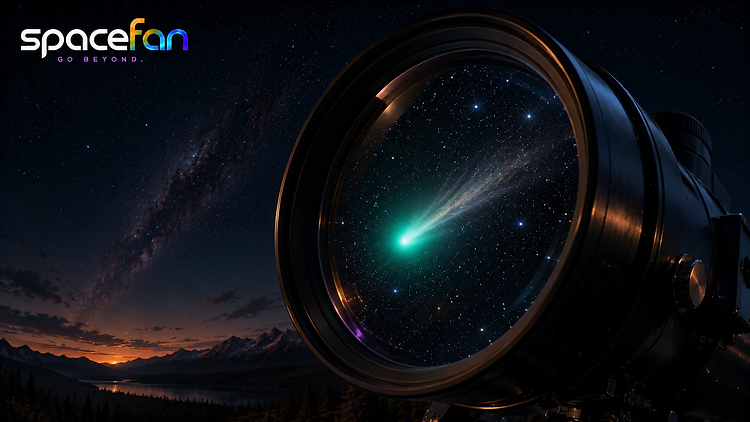
Large telescope lens reflecting a bright green comet beneath the Milky Way above a mountain landscape at dusk.
Image · Space.Fan

The Drop

Space is so big that gravity can act like a giant magnifying glass. When a massive galaxy sits in front of a smaller, farther one, the front galaxy bends the light from the back one. This trick is called strong gravitational lensing. It creates strange rings and arcs of light that help astronomers measure how much matter is hidden in space. However, it is very hard to study these images because they are often blurry or mixed with noise from cameras. Scientists have long struggled to model these complex light patterns accurately. To fix this, researchers built a new computer tool that combines two smart types of artificial intelligence. One part works like an artist creating an image from scratch, while the other acts like a detective checking the work against real data. By working together, these AI programs can create clear, pixel-by-pixel pictures of both the front galaxy and the light from the back galaxy at the same time. This process creates a much more detailed map of how matter is distributed in space than previous methods allowed. The team tested their new tool using realistic computer simulations that mimic the chaos of the real universe. It successfully reconstructed these complex images down to the smallest details, even when the data was very noisy.
Advertisement

Why It Matters

This new method matters because it gives astronomers a clearer lens to study the invisible parts of the universe. Much of the mass in galaxies is made of dark matter, which we cannot see directly. By using this AI to precisely measure how light bends around a galaxy, scientists can figure out exactly how dark matter is spread out. It helps turn messy, low-quality telescope data into sharp, useful information for studying how galaxies grow over billions of years.
Advertisement

The Catch

This is a computer model based on simulations, so it is not a direct photograph of a real lens in space yet. While the AI performs very well in tests, it still needs to be proven on real data from powerful space telescopes. It is also limited by the quality of the training data used to teach the AI, meaning the real universe might hold unexpected surprises that the model hasn't learned to recognize yet.

Put That in Perspective

Scientists have spent years using basic math to calculate these light bends, but the math becomes too slow when looking at high-resolution images. This shift toward using AI, specifically diffusion models, represents a major change in how we process telescope data. Researchers will likely look to apply this method to upcoming deep-space surveys to map the mass of distant galaxy clusters more quickly than ever before.

Source November 16, 2026
ApJ

Keep Exploring Space