Advertisement
Space.Fan — Go Beyond
ApJ · 1 DAY AGO
Sun & Space WeatherPEER REVIEWED

Parker Solar Probe Reveals Secrets of Turbulent Solar Wind

By Space.Fan Editorial Desk

New data from our closest solar visitor shows how energy moves through the chaotic magnetic fields near the Sun.
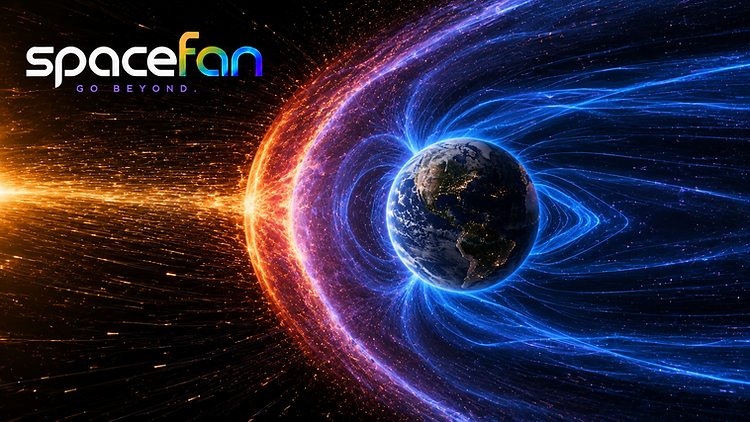
Earth surrounded by glowing magnetic field lines as solar particles strike the magnetosphere.
Image · Space.Fan

The Drop

NASA's Parker Solar Probe is currently flying closer to the Sun than any spacecraft before it. Its goal is to study the solar wind, which is a constant stream of charged particles flowing away from the Sun's surface. Scientists have long wondered how the magnetic energy in this wind changes as it moves through space. By looking at the data collected by the probe, researchers discovered that the solar wind behaves differently depending on the direction of the magnetic field. In some directions, the energy stays consistent, while in others, it smooths out. To figure out why this happens, the team looked for tiny pockets of organized energy. They found that these organized structures act like little engines that change how the surrounding energy is spread out or broken down. This study uses high-speed measurements to map these patterns in incredible detail. By tracking how these structures interact with the background flow of the solar wind, scientists are getting a better picture of how energy is transferred throughout the Sun's atmosphere.
Advertisement

Why It Matters

Understanding how solar wind creates heat and energy is a major challenge for space science. Because space is full of plasma, which is a gas made of charged particles, it behaves like a complex fluid. This study helps explain how energy is lost or moved in this environment without particles bumping into each other. This is important for learning how the Sun's outer atmosphere gets so incredibly hot.
Advertisement

The Catch

This research focuses specifically on the 'slow' solar wind found near the Sun. The Sun also produces 'fast' solar wind, which might behave differently. Additionally, the probe is only catching a tiny slice of the space around the Sun at any given time, so scientists must use mathematical models to guess what is happening in the wider areas they cannot directly measure.

Put That in Perspective

Scientists have studied solar turbulence for decades, but the Parker Solar Probe provides the first high-quality, close-up look. Future research will likely focus on whether these patterns hold true when the Sun is at different points in its activity cycle.

Source September 21, 2026
ApJ

Keep Exploring Space