Advertisement
Space.Fan — Go Beyond
ApJ · 6 DAYS AGO
UniverseSIMULATION

Solving the Mystery of Cosmic Candle Explosions

By Space.Fan Editorial Desk

New simulations show how stars become bright cosmic landmarks, helping astronomers map the universe more accurately than ever before.
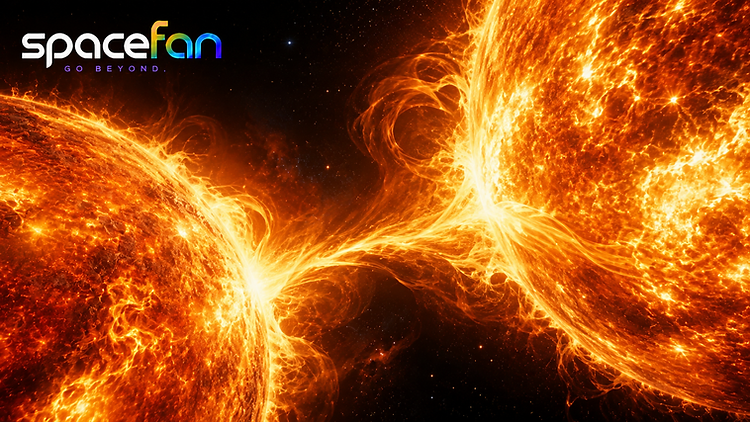
Two fiery stars interacting through huge glowing loops and streams of stellar plasma.
Image · Space.Fan

The Drop

Type Ia e are massive explosions that act like perfect cosmic rulers. Because they always shine with almost the same brightness, scientists use them as candles to measure how far away galaxies are. For a long time, we knew these explosions came from a white dwarf gaining material from a companion , but we did not fully understand the exact moment the turned into a bomb. Scientists have previously relied on guesses or ad hoc assumptions to fill in the gaps of how this explosion begins. Now, a research team has used supercomputer simulations to look inside these dying s. By creating complex 3D models, they watched how hot, swirling gas inside the changes from a slow burn into a powerful, rapid explosion. This new process, called a turbulence-driven deflagration-to-detonation transition, shows exactly how the rips itself apart. The most exciting result is that no matter how the ts, the explosion reaches a point where it always follows the same physical path. This discovery explains why these s appear so consistent in our sky, confirming why they are such reliable tools for measuring the vast distances of space. Researchers were even able to match the light patterns from their computer models to an actual observation from 1999, which gives them high confidence that their digital experiment reflects real-world physics.
Advertisement

Why It Matters

Understanding the exact mechanism of these explosions is critical for cosmology. If we know the physical 'why' behind their brightness, we can trust our measurements of the universe's expansion rate even more. This model removes the need for scientists to use 'tuned' guesses, providing a solid scientific foundation for why these s always behave the same way.
Advertisement

The Catch

While these simulations are a huge step forward, they are still models created on a computer. The team notes that the process might work differently in s that are not quite as massive as the ones studied here. More research is needed to see if this mechanism can explain other types of e that do not shine as brightly or appear differently, such as Type Iax events.

Put That in Perspective

Scientists plan to continue refining these simulations to explore how different starting conditions change the explosion's final look. This work builds upon decades of trying to solve the mystery of what triggers the ultimate destruction of a white dwarf star.

Source November 16, 2026
Krut Patel, Akshay Dongre, Robert Fisher, Alexei Poludnenko, Vadim Gamezo, Mark Ivan Ugalino, Chris Byrohl
University of Massachusetts Dartmouth, University of Connecticut, Naval Research Laboratory, University of Maryland, Universität Heidelberg·The Astrophysical Journal·10.3847/1538-4357/aeb7de

Keep Exploring Space