Advertisement
Space.Fan — Go Beyond
ApJ · 5 HR AGO
Sun & Space WeatherPEER REVIEWED

Solving the Mystery of Cosmic Rays During Solar Storms

By Space.Fan Editorial Desk

Scientists found a new way to track how high-energy space particles change when our sun gets stormy.
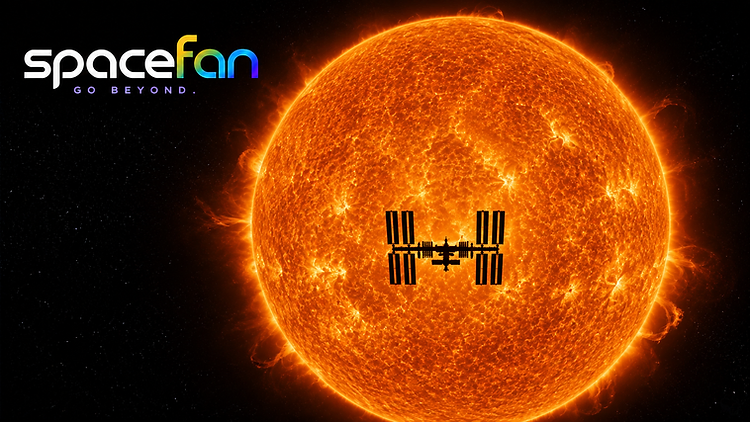
Silhouette of the International Space Station crossing in front of the bright orange Sun.
Image · Space.Fan

The Drop

Outer space is filled with high-energy particles called galactic cosmic rays that travel toward us from deep space. In late 2017, scientists noticed that the number of these particles reaching our area of the solar system suddenly dropped. This happened while the sun was becoming less active, but a series of powerful solar storms, known as coronal mass ejections, were passing through space. These giant clouds of solar material acted like a shield, blocking some of the cosmic rays from reaching us. To study this, researchers used data from a sensitive instrument on the International Space Station called the Alpha Magnetic Spectrometer, or AMS-02. This machine acts like a high-tech filter that counts and sorts the particles hitting it. Scientists compared the data from 2017 to their computer models to see if their math matched what the instrument actually saw. At first, the standard models did not quite make sense. When they tried to make the math work for the 2017 data, it suggested that the particles were moving in a way that contradicted known laws of physics. By changing how they calculated the movement of these particles, the researchers found a much better fit that matches what we know about how particles travel through space.
Advertisement

Why It Matters

This discovery helps scientists create more accurate models of how space weather affects our solar system. By realizing that the way particles bounce off magnetic fields changes during solar storms, researchers can better predict the movement of radiation. This is important for protecting satellites and astronauts who travel outside of Earth's protective atmosphere, as they are exposed to these high-energy particles.

Aurora Tonight

Live NOAA outlook

Slight aurora activity

Mostly Arctic: Alaska, northern Canada, Greenland, and far-northern Europe

Aurora activity34%
Peak Kp tonight: 3.7NOAA nowcast max: 17%Source: NOAA SWPC

Aurora forecasts are probabilistic. Darkness, clouds, local light pollution, and rapidly changing solar-wind conditions affect what you can actually see.

Advertisement

The Catch

This work relies on a specific computer model to interpret the data. While the new method fixes the inconsistency, it is still a model based on certain assumptions about how particles behave. It does not mean we have a perfect map of all cosmic rays, only a better way to explain this specific event from 2017.

Put That in Perspective

Scientists have studied cosmic rays for decades, but modern instruments like the AMS-02 allow for much more precise measurements than were possible in the past. This study provides a template that researchers can now use to look at other solar events to see if the same patterns hold true.

Source October 2, 2026
O. P. M. Aslam, D. MacTaggart, M. S. Potgieter, M. D. Ngobeni, I. I. Ramokgaba
University of Glasgow, Christian-Albrechts-University of Kiel, Sol Plaatje University, North-West University·The Astrophysical Journal·10.3847/1538-4357/aea403

Keep Exploring Space