Advertisement
Space.Fan — Go Beyond
ApJ · 9 HR AGO
Sun & Space WeatherMODEL

Solving the Mystery of Magnetic Twists in the Sun's Solar Wind

By Space.Fan Editorial Desk

Scientists have developed a new way to map how magnetic fields in the solar wind shift and turn as they travel through space.
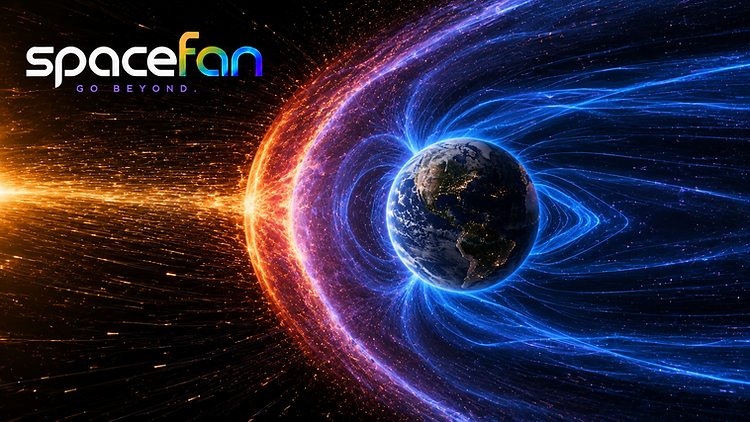
Earth surrounded by glowing magnetic field lines as solar particles strike the magnetosphere.
Image · Space.Fan

The Drop

The Sun constantly sends a stream of charged particles and magnetic fields into space, which we call the solar wind. This stream is not smooth like a calm river. Instead, it is very messy and turbulent. As the solar wind travels, the direction of its magnetic field changes rapidly, even while the total strength of that field stays mostly the same. Scientists have long struggled to predict how these sharp, jerky movements happen. To figure this out, a team of researchers built a new mathematical model. They used a concept called the Ornstein-Uhlenbeck process, which is a way to describe how things change randomly over time. By applying this to data collected from space, they were able to match their predictions with real-world measurements of how the magnetic field turns and flips. The team found that when these changes happen over a long time, they follow a predictable pattern. They behave like a series of random events that occur one after another. However, when the changes happen very quickly, they reveal the rough and chaotic nature of the plasma. This gives us a clearer picture of the invisible structure within the solar wind. This study provides a better way to look at current sheets and other messy magnetic features in space. By understanding these small, sudden movements, scientists are building a stronger foundation for mapping the overall behavior of the Sun's magnetic environment.
Advertisement

Why It Matters

Understanding these magnetic rotations is vital for space weather forecasting. The solar wind can affect satellite communications, power grids, and the safety of astronauts traveling outside Earth's protective atmosphere. By mastering the physics of these magnetic twists, scientists can better predict the conditions of the space environment near our . This model also helps bridge the gap between how we see small-scale turbulence and large-scale space events. It confirms that even in the most chaotic parts of space, there is an underlying order that we can describe with math.
Advertisement

The Catch

This research is based on a mathematical model that simplifies a very complex physical system. While the model aligns well with current measurements, it does not account for every possible variable in the chaotic solar wind. It acts as a framework for understanding, but it cannot predict exactly when or where an individual magnetic shift will occur in real-time.

Put That in Perspective

Scientists have studied solar wind turbulence for decades, but new, high-quality data from space missions has allowed for much more precise modeling. Future research will likely focus on applying this model to even more extreme conditions to see how well it holds up under different solar activity levels.

Source October 2, 2026
N. H. Bian, Gang Li, S. Y. Huang, A. Chian
Macau University of Science and Technology, Wuhan University, Adelaide University, National Institute for Space Research (INPE)·The Astrophysical Journal·10.3847/1538-4357/aea087

Keep Exploring Space