Advertisement
Space.Fan — Go Beyond
arXiv · 3 DAYS AGO
UniverseSIMULATION

Solving the Mystery of Missing Light in Supermassive Black Holes

By Space.Fan Editorial Desk

Scientists have uncovered why the light around massive black holes looks smoother than our best math models once predicted.
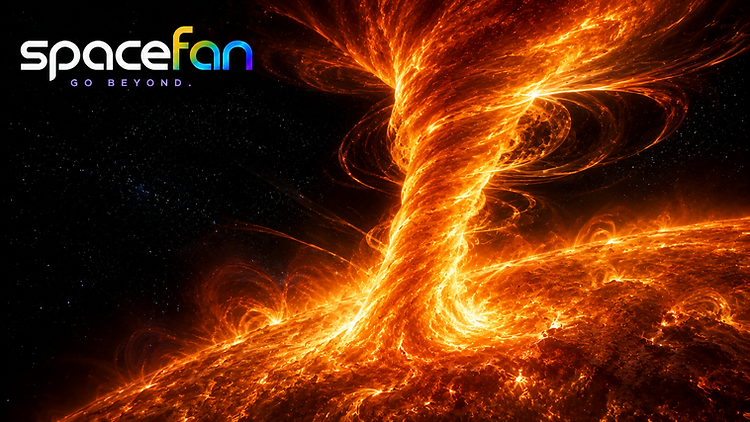
Huge twisting prominence of glowing plasma erupting above the surface of the Sun.
Image · Space.Fan

The Drop

Active galactic nuclei are the incredibly bright hearts of distant galaxies, powered by giant s. These s are surrounded by disks of swirling, superheated gas. For years, scientists have used computer models to predict how these disks should glow in ultraviolet light. Specifically, these models predicted a sharp feature called a Lyman edge, which acts like a sudden drop-off in light brightness. However, when astronomers look at real galaxies, that sharp edge is missing. To figure out why, a team of researchers built a new, highly detailed 3D computer simulation. They modeled how magnetic forces affect the gas inside these disks around a one hundred million times more massive than our Sun. Unlike older models that focused heavily on radiation pressure, this new simulation shows that magnetic fields play a much larger role in shaping the disk. The simulation revealed that disks supported by magnetic pressure are much less dense than scientists previously thought. Because the gas is spread out more thinly, it does not create the sharp, dark Lyman edge that older, denser models expected. Instead, the light remains smooth and continuous, which perfectly matches what astronomers see in the real universe.
Advertisement

Why It Matters

This discovery helps fix a long-standing disagreement between our best physics theories and actual observations of the night sky. By showing that magnetic fields are the missing piece of the puzzle, scientists can now create more accurate models of how matter falls into s. This provides a clearer understanding of how these powerful objects grow and shine over billions of years.
Advertisement

The Catch

While the simulation explains the missing light, it only covers a specific part of the disk. A large amount of the light in these systems actually comes from the very center, right near the , which this specific simulation was not able to include. Future research will need to expand the model to cover those innermost areas to confirm that the effect stays the same throughout the entire disk.

Put That in Perspective

Scientists have been trying to reconcile these computer models with telescope data for a long time. The next steps for the team involve testing a wider variety of black hole feeding rates and adding even more complex physics to see if the magnetic effect remains consistent in different environments.

Source September 22, 2026
Ish Kaul, Yan-Fei Jiang, Omer Blaes, Lizhong Zhang
ApJL·10.48550/arXiv.2609.22421

Keep Exploring Space