Space.Fan — Go Beyond
ApJ · 22 MIN AGO
Sun & Space WeatherSIMULATION

Solving the Mystery of Solar Flare Radio Bursts

By Space.Fan Editorial Desk

New simulations show how tiny particles in solar flares create the radio signals that space weather experts track.
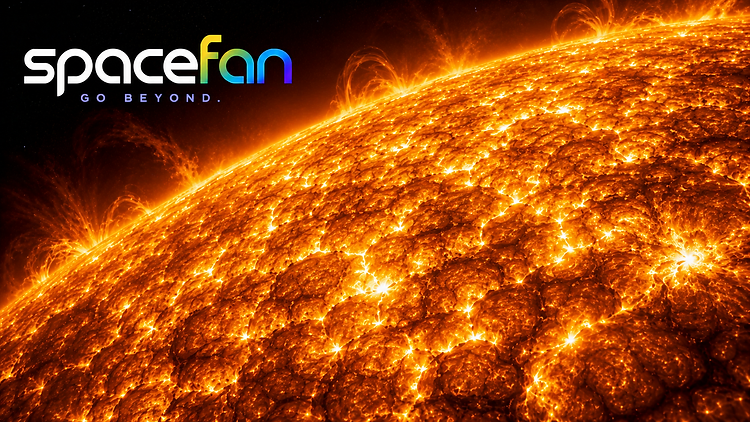
Close-up of the fiery Sun showing bright active regions and looping plasma above its surface.
Image · Space.Fan

The Drop

Solar flares are powerful explosions on the sun that release a huge amount of energy. These events often produce two things: high-energy particles called X-rays and long, wiggling radio signals known as radio fiber bursts. Scientists have long wondered how both of these things can happen during the same flare. To solve this, researchers used advanced computer models to simulate the hot, electrified gas found in the sun's outer layer. By creating a digital 'particle-in-cell' simulation, they could watch how energy flows at a microscopic level. The team found that specific patterns of ion movement create waves of energy. These waves act like a slingshot, tossing electrons to very high speeds to create X-rays. At the same time, this motion creates secondary energy waves called whistler waves, which are responsible for the radio signals we detect. The simulation showed that the way these particles interact depends on how fast they move compared to the magnetic field. When the movement is slower, it creates the perfect conditions to produce both the X-rays and the radio bursts we see from Earth.
Advertisement

Why It Matters

This study is important because it connects two different types of solar activity into one single explanation. Before this, it was hard to prove how the same flare could produce such different signals at the same time. By identifying a microscopic link, researchers now have a better framework to understand the complex physics inside a solar flare.
Advertisement

The Catch

This research is based on computer simulations, which are idealized versions of the sun. While these models are very good at following the rules of physics, they cannot capture every single tiny detail of the actual, messy solar environment, meaning real-world flares might have extra factors not included here.

Put That in Perspective

Scientists have studied solar radio bursts for decades, but pinning down the exact cause was difficult. By using high-speed computing to look at the 'kinetic' level—where individual particles move—researchers are finally seeing the hidden mechanisms that drive our sun's most energetic displays.

Source November 24, 2026
A. R. Soto-Chavez, C. Crabtree, G. Ganguli
U.S. Naval Research Laboratory·The Astrophysical Journal·10.3847/1538-4357/aeb117

Keep Exploring Space