Advertisement
Space.Fan — Go Beyond
PSJ · 2 DAYS AGO
Asteroids & CometsPEER REVIEWED

Space Scientists Reveal What Most Small Asteroids Near Earth Are Made Of

By Space.Fan Editorial Desk

A new study uses a smart computer model to uncover the true makeup of small rocks floating near our home planet.
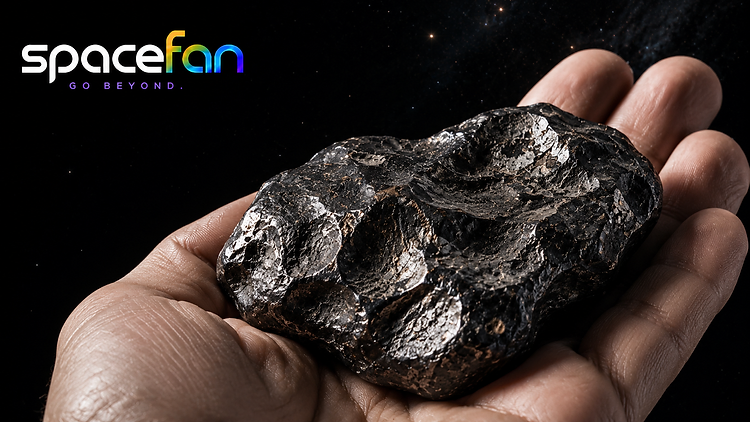
Dark metallic-looking meteorite resting in the palm of a person's hand.
Image · Space.Fan

The Drop

For a long time, it has been hard for astronomers to figure out what tiny s near Earth are made of. These space rocks are often very small, spin quickly, and are only visible for a short window of time. To solve this, a team of researchers looked at data from a large survey conducted over eight years using the UKIRT telescope in Hawaii. They carefully tracked 122 different space rocks that ranged in size from about 16 feet to 500 feet wide. The team used a special way to measure the light reflecting off these rocks, known as near-infrared spectrophotometry. By looking at how the s reflect different colors of light, the scientists could guess what materials were on the surface. They used a machine learning computer program to classify the s based on this light data. At first glance, it looked like the space rocks were split evenly between different types. Some appeared to be made of stony material, while others were made of dark, carbon-rich material. However, the researchers realized that these initial results were misleading because of the way telescopes pick up brighter, stony objects more easily than darker, carbon-rich ones. Once the team adjusted their numbers to account for these biases, a much clearer picture emerged. They found that the population of small rocks near Earth is actually dominated by dark, carbon-rich bodies. This means that if you could see all the rocks in space, the darker, soot-like ones would be much more common than the bright, rocky ones we might expect to see.
Advertisement

Why It Matters

This discovery is important because it helps scientists understand why the meteorites we find on Earth look the way they do. Many of these dark, carbon-rich s seem to break apart or burn up entirely before they can make it through our atmosphere to become meteorites on the ground. Knowing this helps researchers fix their models for how s move from the main belt toward Earth. It also helps space agencies plan better missions to visit these objects and improves our ability to defend the if a dangerous were ever discovered heading toward us.
Advertisement

The Catch

This study relies on computer modeling to 'debias' the results, which means the final conclusion is based on how well the model understands observational errors. While the researchers corrected for the fact that dark s are harder to see, there is still a chance that some types of rocks were undercounted or misidentified. Additionally, the study focuses on a specific set of 122 objects, so it may not represent every single small in the entire neighborhood of Earth.

Put That in Perspective

Scientists have studied space rocks for decades, but usually, we only get good data on the larger ones. By focusing on objects as small as 16 feet, this research offers a new way to see the smaller 'trash' of our solar system. Future research will likely focus on comparing these findings to even smaller meteors observed in the atmosphere to confirm how much of this dark material truly disappears when it hits our air.

Source September 20, 2026
Andy J. López-Oquendo, David E. Trilling, Michael Mommert, Michaël Marsset
NASA Goddard Space Flight Center, Northern Arizona University, Stuttgart Technical University of Applied Science, European Southern Observatory·The Planetary Science Journal·10.3847/PSJ/ae9f3f

Keep Exploring Space