Advertisement
Space.Fan — Go Beyond
ApJS · 8 DAYS AGO
Sun & Space WeatherNEW OBSERVATION

Spacecraft Team Up to Track Mysterious Solar Particles

By Space.Fan Editorial Desk

Three space probes used a rare alignment to study how tiny, high-energy particles move through the solar system.
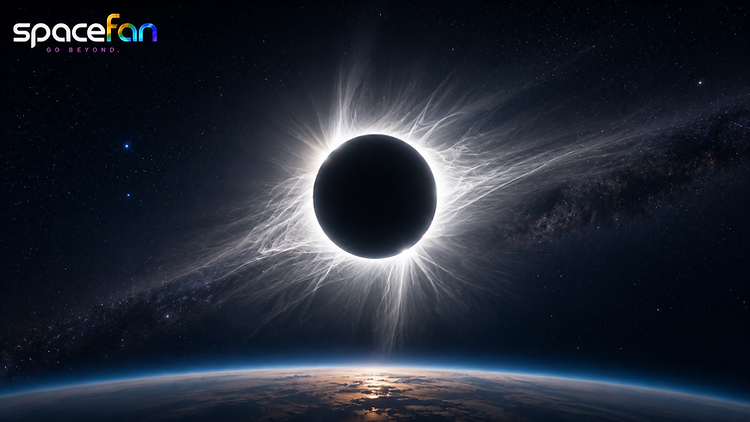
Total solar eclipse with a brilliant white corona suspended above the curved horizon of Earth viewed from space.
Image · Space.Fan

The Drop

In early February 2026, three different spacecraft—Solar Orbiter, ACE, and the new IMAP probe—captured a rare event. They watched the sun release a special group of high-energy particles known as helium-3 ions. Because the spacecraft were lined up in space at just the right time, scientists could watch how these particles traveled through the solar system from different distances. Each craft used special instruments to count and track these particles as they zoomed past. One instrument, called CoDICE, played a big role in watching how these particles flowed toward Earth. By comparing the data from all three locations, researchers were able to see how the particles spread out as they moved further from the sun. The team found that as the particles traveled away from the sun, they thinned out in a specific way that matches how waves expand in space. They also noticed that the particles sometimes disappeared or reappeared because of the sun's complex magnetic field lines acting like invisible tunnels.
Advertisement

Why It Matters

Understanding how these particles travel is very important for protecting astronauts and technology. When the sun shoots out these energetic particles, they can interfere with satellites or be dangerous for humans in deep space. By figuring out exactly how these particle clouds expand and interact with magnetic tunnels, scientists can better predict when and where these high-energy storms might hit.
Advertisement

The Catch

While this study provides great data, it is still hard to know everything about these particle flows. The researchers are not yet certain if these magnetic 'tunnels' change based on the sun's latitude or other factors. Because space is huge and the spacecraft only sample small parts of it, there are still pieces of the puzzle missing regarding how the magnetic fields bend and twist in deep space.

Put That in Perspective

Scientists have tracked solar particles for a long time, but having three probes so perfectly aligned is a rare opportunity. This study acts as a test for the new IMAP mission, proving that it can work with older satellites like ACE to provide a much larger view of the sun's environment than we could get with a single probe.

Source November 15, 2026
ApJS

Keep Exploring Space