Advertisement
Space.Fan — Go Beyond
ApJ · 5 DAYS AGO
UniverseSIMULATION

Spotting the First Light of a Dying Star's Explosion

By Space.Fan Editorial Desk

Scientists have created new computer models to help us see the brilliant flash of a star's final moments.
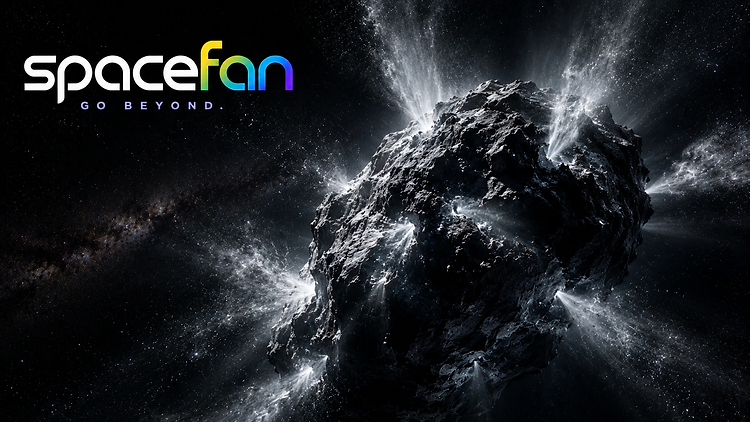
Dark comet nucleus releasing bright jets of gas and dust into surrounding space.
Image · Space.Fan

The Drop

When a massive runs out of fuel, it explodes in a giant event called a . Before the whole blows apart, a powerful shockwave moves from the center to the outside. When this shock finally reaches the surface, it creates a massive burst of light known as a shock breakout. This flash is one of the most exciting parts of a 's death because it carries secret information about what the was like before it exploded. By studying this light, experts can learn how the lived and what surrounded it in space. Because this flash happens so quickly, it has been hard to capture in real life. To solve this, researchers used advanced computer simulations to see what this event looks like in high detail. They studied red supergiant s, which are s that have puffed up to a very large size, and placed them in a cloud of gas and dust. Their computer model acted like a digital laboratory, showing how the shockwave travels through this material. The simulations showed that the shockwave heats up the gas surrounding the . This creates a specific, bright glow that can last for hours or even days. The team found that the brightness and the length of this flash depend on how much dust and gas is surrounding the . They also discovered that the explosion creates a special type of high-energy light that should be visible to our newest space telescopes. Now that researchers know what to look for, they can better prepare for when a actually happens in our galaxy. By knowing exactly what patterns to scan for, telescopes like the Einstein Probe can watch for these quick flashes in the X-ray and ultraviolet light bands. These digital blueprints act as a map for scientists to find these explosive events in the future.
Advertisement

Why It Matters

Understanding the shock breakout is like finding the 'black box' of a plane crash; it tells us exactly how the died and what it was made of. This study confirms that the material surrounding a plays a huge role in how we see the explosion, which helps us connect the dots between a 's life and its final, violent end. This research also helps astronomers turn their telescopes toward the right spots at the right time. By providing a clear list of signs to watch for, the study makes it much more likely that we will successfully catch a in the act of ting, rather than just seeing the aftermath.
Advertisement

The Catch

These findings come from computer models, not from looking at real s through a telescope. While the physics in these simulations are very detailed, they are still just a mathematical representation of a . The real universe might be more chaotic or different in ways the computer program did not account for, so we must wait to confirm these signals with actual data from space.

Put That in Perspective

In the past, astronomers mostly looked for the lingering, fading light of a supernova days or weeks after it occurred. This new work shifts our focus to the very first moments of the event, pushing our observational limits to the edge of what current technology can detect.

Source November 18, 2026
ApJ

Keep Exploring Space