Advertisement
Space.Fan — Go Beyond
ApJ · 6 HR AGO
DiscoveriesPEER REVIEWED

Super-Bright Supernova Found Creating Massive Amounts of Space Dust

By Space.Fan Editorial Desk

Astronomers discovered that a rare, extra-bright exploding star is acting like a giant factory for cosmic dust.
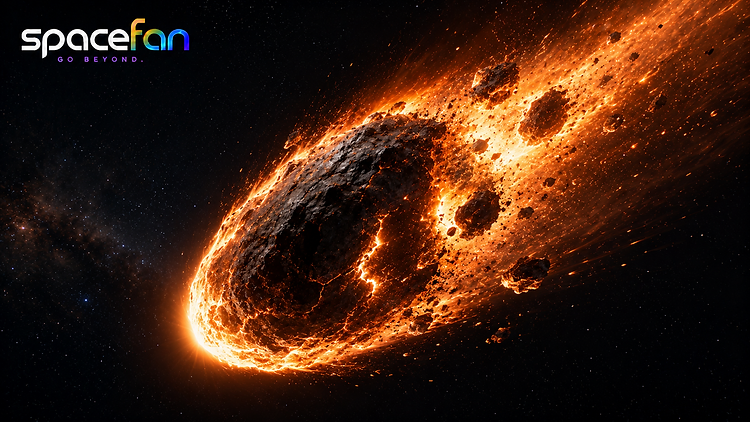
Large fractured asteroid engulfed in flames and glowing debris as it travels through space.
Image · Space.Fan

The Drop

When a massive dies in a giant explosion called a , it usually leaves behind a lot of gas. Scientists have been studying one specific, extra-bright explosion known as SN 2018bsz. For a long time, researchers watched it fade away using powerful telescopes. Even after the bright light of the explosion disappeared from our view in regular light, they noticed something strange: it was still glowing brightly in infrared light. This glow showed that something warm was hiding inside the cloud left behind by the . To figure out what was happening, the team used complex computer models to test different ideas. They ruled out the possibility that the light was just reflecting off nearby gas or dust. Instead, the evidence shows that the explosion is actually creating its own brand-new dust. Over several hundred days, the amount of dust grew from a small pile into a massive cloud. This discovery proves that these extra-bright, or superluminous, explosions can make much more dust than the typical exploding s we see in our own galaxy.
Advertisement

Why It Matters

This finding helps astronomers solve a long-standing mystery about the early universe. In the beginning, the universe was filled with dust that helped create the first s and s. We know that some s create dust, but scientists have struggled to explain where all the dust in the early universe came from. Since these special, extra-bright e are common in galaxies that look like the ones from the early universe, they could be the primary source of all that missing dust.
Advertisement

The Catch

While the evidence strongly supports the idea that the is making dust, the team had to use models to interpret the light signatures they collected. Because the event happened very far away, we cannot visit it or see the dust particles directly. The researchers are confident in their conclusion because other explanations for the infrared glow did not match the way the light changed over time, but it remains a model-based discovery.

Put That in Perspective

Normal supernovae are famous for making dust, but this one makes roughly ten times more than the ones we see in our local neighborhood. By studying this star, researchers are getting a clearer look at how the building blocks of planets were made billions of years ago.

Source September 26, 2026
ApJ

Keep Exploring Space