Advertisement
Space.Fan — Go Beyond
ApJL · 22 HR AGO
Sun & Space WeatherPEER REVIEWED

Testing How Solar Storms Travel from the Sun to Earth

By Space.Fan Editorial Desk

Scientists are checking how well computer models can predict the arrival of giant solar explosions that hit our planet.
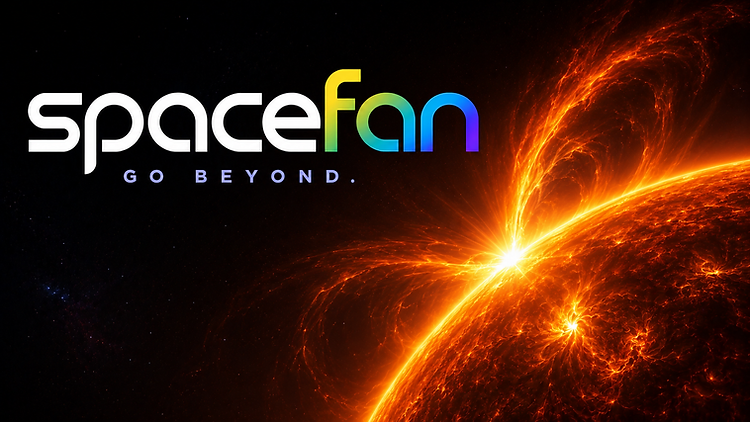
A bright solar flare erupting from the surface of the Sun.
Image · Space.Fan

The Drop

When the sun has a big eruption, it sends a blast of energy and particles toward Earth. These events are called solar shocks. Scientists use computer programs to guess when these shocks will arrive. One common program is called the Shock Propagation Model, or SPM3 for short. Researchers wanted to know how accurate this program really is by testing it against data from real space missions. To do this, the team used information from four different spacecraft: SOHO, Parker Solar Probe, Solar Orbiter, and Wind. By looking at how these ships recorded the same shock waves at different times and places in space, the team could see if the computer model matched what actually happened. They checked three different routes that a solar shock might take, ranging from the sun directly to Earth or stopping at other spacecraft along the way. The results showed that the model does a decent job, but it is not perfect. It was able to correctly predict when a shock would arrive between 62% and 69% of the time, depending on the path. The researchers found that the model often predicted the arrival time a little too early, sometimes by several hours.
Advertisement

Why It Matters

Understanding these solar shocks is important because they can cause space weather events that might disrupt satellites, GPS, or power grids on Earth. Knowing when a shock will hit helps people prepare for these disruptions. By checking where the model makes mistakes, scientists can figure out how to improve their tools for better safety.

Aurora Tonight

Live NOAA outlook

Low aurora activity

Mostly Arctic: Alaska, northern Canada, Greenland, and far-northern Europe

Aurora activity22%
Peak Kp tonight: 2.3NOAA nowcast max: 12%Source: NOAA SWPC

Aurora forecasts are probabilistic. Darkness, clouds, local light pollution, and rapidly changing solar-wind conditions affect what you can actually see.

Advertisement

The Catch

This study shows that errors in the computer model tend to build up as the shock wave moves further away from the sun. Because the model relies on certain assumptions about how the solar wind flows, it cannot capture every small detail of a solar storm. The researchers noted that more than half of the error is already present by the time the storm has traveled about two-thirds of the way to Earth.

Put That in Perspective

Scientists are now looking at how different speeds of solar wind and the path a storm takes change the final result. Future studies will likely focus on fixing these specific error patterns to make space weather forecasts more reliable for everyone.

Source November 21, 2026
Mingda Guo, Xinhua Zhao, Nanbin Xiang, Shiwei Feng, Jiaqi Chai, Yidan Liang, Xinyu Yu, Chenyu Shi, Xueshang Feng
National Space Science Center, University of Chinese Academy of Sciences, Yunnan Observatories, Shandong University·The Astrophysical Journal Letters·10.3847/2041-8213/aeba8d

Keep Exploring Space