Advertisement
Space.Fan — Go Beyond
ApJL · 2 DAYS AGO
UniversePEER REVIEWED

Tiny, Young Galaxies Fueled the Early Universe

By Space.Fan Editorial Desk

Astronomers used the James Webb Space Telescope to find tiny, energetic dwarf galaxies that helped clear the fog of the early universe.
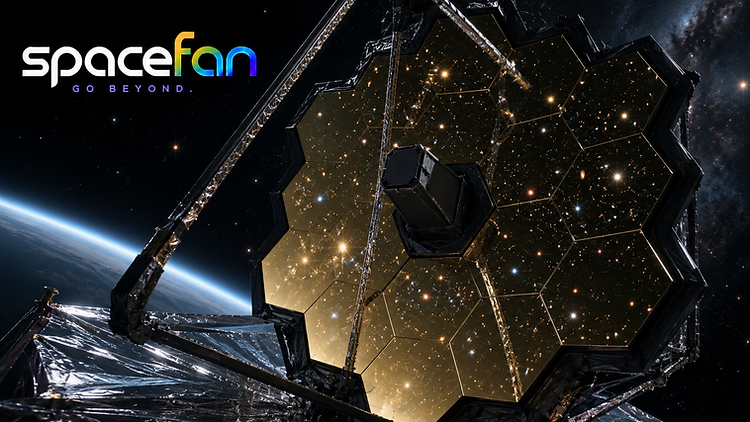
James Webb Space Telescope in space with its gold segmented mirror facing the stars.
Image · Space.Fan

The Drop

Scientists have studied 14 special galaxies that existed when the universe was very young. These galaxies are called luminous Lyman-alpha emitters. By using the powerful James Webb Space Telescope and ground-based telescopes, researchers were able to get a much clearer look at these ancient objects than ever before. This allowed them to see details that were previously hidden by blurry images. The data shows that these galaxies are not huge monsters. Instead, they are very small, young dwarf galaxies that are bursting with new s. They are less than 10 million years old and contain very little dust. Because they are so bright and energetic, they act like powerful engines pumping out light and energy. This activity makes them extremely efficient at leaking high-energy light out into the surrounding space. The team found that dust inside the galaxies is the main thing that blocks their light, rather than hydrogen gas as previously thought.
Advertisement

Why It Matters

These small galaxies are important because they lived during a time called the Epoch of Reionization. At that time, the universe was filled with a thick fog of neutral gas. These tiny, bright dwarf galaxies produced enough energy to help clear that fog, allowing light to travel freely through space. Understanding how these small systems work helps us see how the early universe changed from a dark, foggy place into the transparent universe we see today.
Advertisement

The Catch

While these results are exciting, they are based on a specific sample of 14 galaxies. These are some of the brightest examples of their kind, so they might not represent every single dwarf galaxy from that era. Because these galaxies are so far away, researchers still have to use complex computer models to estimate their exact mass and age, which can leave room for small errors in our calculations.

Put That in Perspective

Scientists have long wondered what objects provided the energy to clear the early universe's gas. These findings suggest that small, frequent starbursts from dwarf galaxies were likely the primary drivers, rather than just large, rare galaxies. Researchers plan to use this information to compare these distant systems with similar, smaller galaxies in our own local neighborhood.

Source September 15, 2026
Yuanhang Ning, Zheng Cai, Linhua Jiang, Qiong Li, Si-Yue Yu, Xiaodi Yu, Zhen-Ya Zheng
Beijing Planetarium, Tsinghua University, Peking University, University of Manchester, Xiamen University, Dali University, Shanghai Astronomical Observatory·The Astrophysical Journal Letters·10.3847/2041-8213/aea091

Keep Exploring Space