Advertisement
Space.Fan — Go Beyond
ApJL · 1 DAY AGO
DiscoveriesPEER REVIEWED

Webb Telescope Detects Hidden Light from Key Space Molecule

By Space.Fan Editorial Desk

Astronomers have finally spotted a rare, forbidden light signal from the H3+ molecule in deep space using the James Webb Space Telescope.
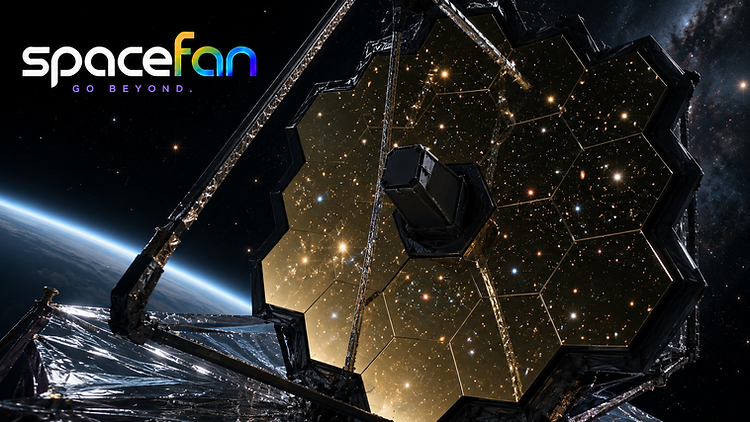
James Webb Space Telescope in space with its gold segmented mirror facing the stars.

The Drop

The H3+ molecule is like a basic building block for chemistry in space. For a long time, scientists have been able to spot this molecule in the atmospheres of giant s, but they could never see its pure rotational light signal. This specific kind of light is called forbidden because it is very hard to detect under normal conditions. It usually stays hidden from our telescopes. Now, researchers have used the James Webb Space Telescope to find this elusive signal for the first time in a place called HH 168. HH 168 is a bright area where powerful space winds are crashing into gas clouds. The telescope used a special tool called MIRI to pick up twenty-six distinct lines of light. These lines tell us exactly how the molecules are spinning and behaving inside these intense, hot regions of space. By studying this light, scientists can see the hidden fingerprints of molecules that have been invisible to us until now.
Advertisement

Why It Matters

This discovery gives scientists a new way to measure the invisible electrical charges found in clouds of space gas. By tracking these molecules, researchers can better understand how gas clouds act when they are hit by fast-moving shocks. This helps us piece together how s and ary systems are built from the raw materials found in our galaxy.
Advertisement

The Catch

While the data is exciting, it is not perfect. Scientists are still trying to figure out the exact temperature of the gas. The math used to model these shocks is still being improved, and the way these molecules interact with other particles in high-energy collisions is not yet fully understood by researchers.

Put That in Perspective

Before this, scientists could only guess at what was happening with these specific light patterns based on lab tests. Now that we have seen them in real space objects like HH 168 and HH 211, we have a clear path to study these molecular signals across many other parts of the universe.

Source November 21, 2026
David A. Neufeld, Joel D. Green, Dan M. Watson, and Paule Sonnentrucker
Johns Hopkins University, Space Telescope Science Institute, University of Rochester, European Space Agency·The Astrophysical Journal Letters·10.3847/2041-8213/aebe28

Keep Exploring Space