Advertisement
Space.Fan — Go Beyond
ApJL · 1 DAY AGO
DiscoveriesPEER REVIEWED

Webb Telescope Reveals the Hidden History of Ancient Galaxy Disks

By Space.Fan Editorial Desk

Astronomers used the James Webb Space Telescope to study the oldest stars in nearby galaxies, uncovering how they grew over billions of years.
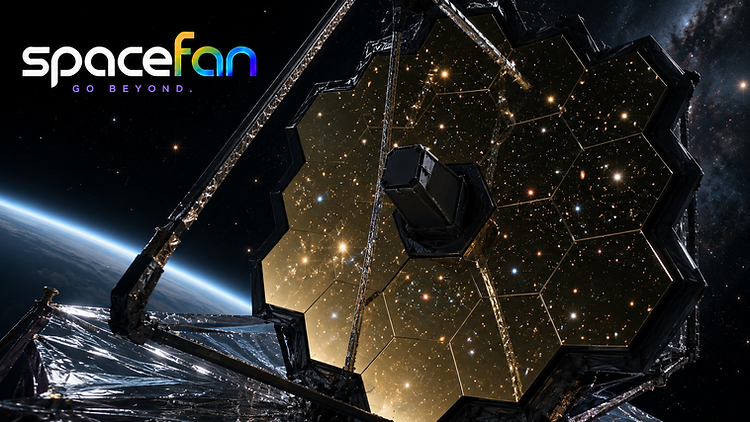
James Webb Space Telescope in space with its gold segmented mirror facing the stars.
Image · Space.Fan

The Drop

Astronomers have found a new way to look back in time at the history of galaxies. By using the powerful James Webb Space Telescope, the team studied a group of very old s known as the red giant branch. These s act like ancient records, telling stories about what the galaxy was like when it first formed billions of years ago. By zooming in on six galaxies located near our own, researchers were able to measure the mass and chemical makeup of these fossil populations. This is the first time anyone has been able to look at the history of these specific disks in such detail. To do this, the team used the telescope to look at infrared light. They studied the color and brightness of the s to figure out how much heavy material, or metals, they contain. Metals in astronomy are any elements heavier than helium. By comparing these observations to computer models, the scientists mapped out a relationship between how massive a galaxy is and how many metals its s hold. The results show that these older, fossil disks share similar patterns with the very first galaxies that formed in the early universe, long before the sun was even born.
Advertisement

Why It Matters

This discovery gives scientists a better map of how galaxies grow and change over time. By linking the properties of modern nearby galaxies to those from the very early universe, researchers can test if their ideas about galaxy evolution are correct. It confirms that the way galaxies built themselves up in the past is consistent with what we see in the present day, providing a missing link between the ancient universe and the modern one.
Advertisement

The Catch

While this study is a breakthrough, it only looked at six nearby galaxies. This is a small sample size, which means it might not represent every single galaxy in the universe. Scientists also rely on complex models to estimate the age and chemical makeup of the s. If these models have any errors, it could change how we understand the results.

Put That in Perspective

Before the James Webb Space Telescope, seeing individual stars in such detail across different galaxies was nearly impossible. This new method provides a way for scientists to study cosmic history in our own neighborhood, paving the way for future studies of many more galaxies.

Source November 21, 2026
Avinash Ck, Divakara Mayya, Alessandro Bressan, Jairo Andres Alzate Trujillo, Léo Girardi, Shaunak Mishra, Bolivia Cuevas-Otahola
Instituto Nacional de Astrofísica, Óptica y Electrónica, SISSA, Osservatorio Astronomico di Padova, Purple Mountain Observatory, Instituto de Astrofísica de Andalucía, LIRA, Observatoire de Paris, Universidad Nacional Autónoma de México·The Astrophysical Journal Letters·10.3847/2041-8213/aebc60

Keep Exploring Space