Advertisement
Space.Fan — Go Beyond
ApJ · 2 DAYS AGO
Sun & Space WeatherSIMULATION

A Better Way to Predict Solar Storms and Space Weather

By Space.Fan Editorial Desk

Scientists have created a new computer model that better explains how powerful solar shockwaves travel through space.
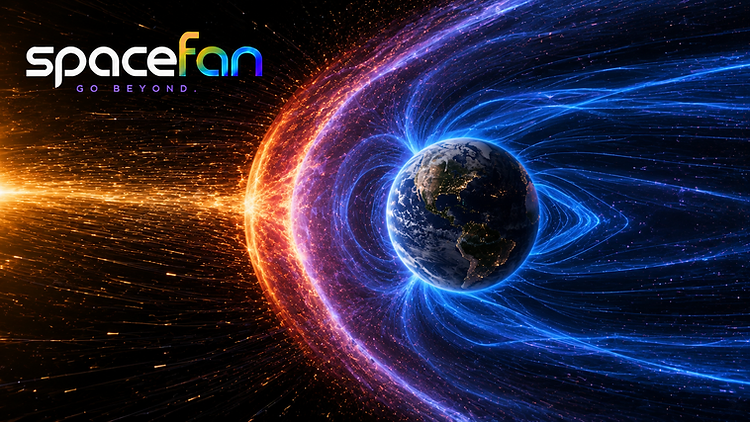
Earth surrounded by glowing magnetic field lines as solar particles strike the magnetosphere.
Image · Space.Fan

The Drop

Space is not empty; it is filled with a thin, electrically charged gas called plasma. When the Sun has a big explosion, it sends out shockwaves of this plasma that can rush toward Earth. These shockwaves can affect satellites and power grids. For a long time, it has been hard for computers to track these moving shocks accurately because the math is very complicated and often misses small, messy details. Researchers have now developed a new way to simulate these events by looking at them from the perspective of the shock itself, rather than from a fixed point in space. This method acts like a camera tracking a runner instead of one watching them pass by from the side of the track. By using this new system, scientists can watch how the plasma behaves over a long time without the simulation getting too fuzzy or inaccurate. This approach allowed the team to see tiny magnetic wiggles in the plasma that usually disappear in older computer models. These little wiggles are important because they play a big role in how hot the plasma gets as it moves through space.
Advertisement

Why It Matters

Understanding how plasma heats up and moves is key to predicting space weather. When solar storms hit Earth, they can cause geomagnetic storms that mess with our technology. By capturing these magnetic wiggles accurately, scientists can better predict how much energy a solar shock will carry when it reaches our . This helps us build better defenses for the satellites and electronics we rely on every day.

Aurora Tonight

Live NOAA outlook

Low aurora activity

Mostly Arctic: Alaska, northern Canada, Greenland, and far-northern Europe

Aurora activity19%
Peak Kp tonight: 2NOAA nowcast max: 13%Source: NOAA SWPC

Aurora forecasts are probabilistic. Darkness, clouds, local light pollution, and rapidly changing solar-wind conditions affect what you can actually see.

Advertisement

The Catch

While this new model is very promising, it is still a computer simulation and not a direct observation of an actual space event. It works well in two-dimensional tests, but real space events are much more complex and exist in three dimensions. Scientists still need to prove that this method will be just as effective when applied to the full, messy reality of the actual solar wind.

Put That in Perspective

In the past, scientists often had to force their models to include extra outside turbulence just to make them look realistic. This new approach creates that turbulence naturally, showing us a much more detailed view of the solar environment than we had before. The team plans to use this to better study cosmic rays and the particles shot out by the Sun.

Source November 20, 2026
Yuri A. Omelchenko, Igor V. Sokolov, Lulu Zhao, Keheng Zhu, Michal Golan
Space Science Institute, University of Michigan, Ben-Gurion University of the Negev·The Astrophysical Journal·10.3847/1538-4357/aeb2f1

Keep Exploring Space