Advertisement
Space.Fan — Go Beyond
ApJ · 1 DAY AGO
Sun & Space WeatherPEER REVIEWED

A New 30-Year Catalog Tracks Magnetic Flip-Flops in the Sun's Wind

By Space.Fan Editorial Desk

Scientists have mapped over 1,000 magnetic boundary crossings to better understand how the Sun shapes the space environment around Earth.
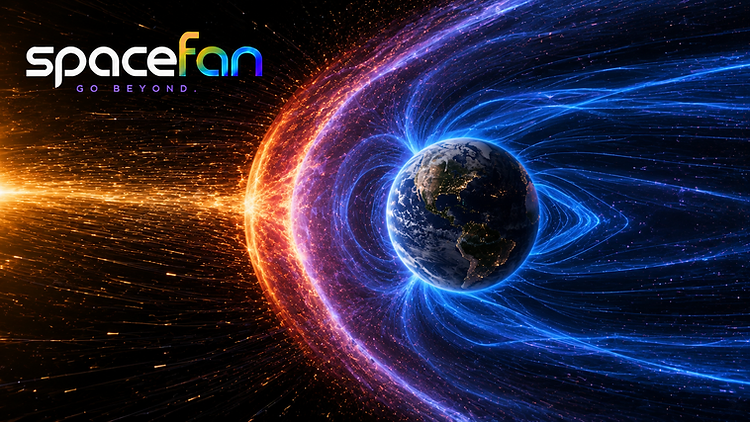
Earth surrounded by glowing magnetic field lines as solar particles strike the magnetosphere.
Image · Space.Fan

The Drop

Our Sun is constantly blowing a stream of charged particles into space called the solar wind. This wind carries magnetic fields that change direction as they travel past Earth. These moments where the magnetic field flips are called sector boundary crossings. They act like large, invisible walls in the solar wind that can shake up the magnetic environment around our . Researchers have now created a massive new database called the SBCross catalog. It keeps track of these crossings by looking at data from the last 30 years, from 1995 all the way to 2026. The team used information from spacecraft that measured the magnetic field and the movement of electrons in the solar wind to pinpoint exactly when these crossings happened. By looking at 1,076 different events, the team found that these boundaries are quite large, averaging about 4.6 million miles thick. They happen about two to three times every time the Sun completes one full rotation. Having this long-term record helps scientists see patterns that were hard to spot before.
Advertisement

Why It Matters

Understanding these boundaries is important because they are a big part of space weather. When these solar structures hit Earth, they can interfere with satellites and radio signals. By studying how often these events happen and how they behave, experts can better predict when space weather might get stormy. This catalog gives scientists a clear, standardized tool to see how the Sun’s magnetic activity changes over many years.
Advertisement

The Catch

While the catalog provides a lot of data, it is not perfect. The researchers used automated computer programs to find these events, which means some smaller or weaker boundary crossings might have been missed. Also, the study shows that solar storms sometimes crash into these boundaries, which changes how they look and act, making it tricky to separate the normal solar wind from the effects of those big solar explosions.

Put That in Perspective

This work updates and expands on older lists of solar boundaries. It covers three full cycles of solar activity, giving us the most complete look at these structures to date. Researchers will likely use this catalog to see how these invisible magnetic walls change as the Sun moves into different phases of its natural activity cycle.

Source November 21, 2026
Stephan G. Heinemann, Manuela Temmer, Mathew Owens, Emilia Kilpua, Charles Farrugia, Daniel Price
University of Helsinki, Institute of Physics at the University of Graz, University of Reading, University of New Hampshire·The Astrophysical Journal·10.3847/1538-4357/aeb926

Keep Exploring Space