Advertisement
Space.Fan — Go Beyond
ApJ · 3 DAYS AGO
UniverseMODEL

A New AI Tool Speeds Up the Study of Dancing Binary Stars

By Space.Fan Editorial Desk

Scientists have created a new computer brain that can figure out how binary star systems work much faster than ever before.
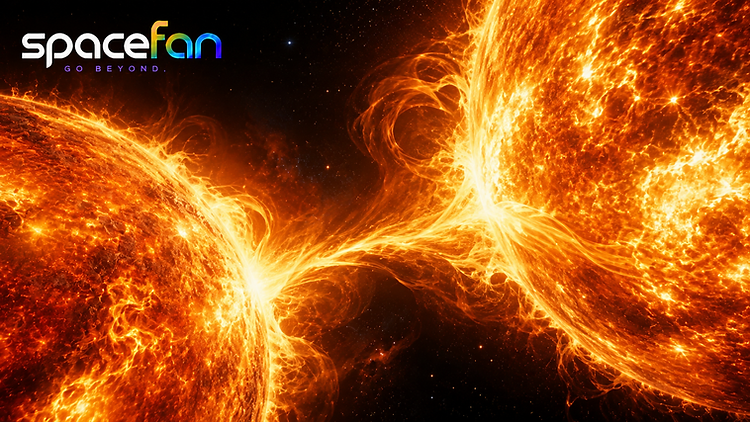
Two fiery stars interacting through huge glowing loops and streams of stellar plasma.

The Drop

Space is filled with pairs of s that orbit so close to each other that they actually touch. These are called contact binaries. Learning about how they spin and orbit helps us understand how s live and die. To do this, astronomers usually look at light curves, which show how the brightness of the s changes over time, and radial velocity, which shows how fast the s move toward or away from us. Studying these s is usually very slow. Scientists have to run complicated math models that take a huge amount of computer power. As we build better telescopes that find thousands of new s, we are getting flooded with more data than we can handle using these old, slow methods. To solve this, researchers built a new tool using a neural network. This is a type of artificial intelligence that learns from examples. They trained the AI to look at the light and movement of s to predict their orbits in a fraction of the time. The team also used a special tool called a SIREN model to make the predictions even more accurate. To prove the tool works, the researchers tested it on fake data they created. By comparing what the AI guessed to the known facts of their fake s, they showed the system is very reliable. This means we can now study massive amounts of data without needing supercomputers for every single one.
Advertisement

Why It Matters

This breakthrough changes how we do astronomy on a grand scale. Before this, checking the data for thousands of s was like trying to read a library of books one word at a time. Now, this AI can do that work almost instantly. By processing this data faster, astronomers can spot patterns in how s evolve that were hidden before. It effectively opens the door to studying populations across the galaxy instead of just looking at one pair at a time.
Advertisement

The Catch

While the AI is very fast and accurate, it is still a computer model. It was tested on synthetic data, which means it was trained on perfect, computer-made information. Real space data is often messy, full of interference, and harder to read. The team still needs to prove the AI can handle the tricky, noisy data that comes from real-world telescopes.

Put That in Perspective

In the past, astronomers had to wait days or weeks for their computer models to finish processing a single star system. This new AI is a huge step forward in catching up with the 'big data' age of space science. Next, researchers will likely test this tool on real observations to see if it can handle the imperfections of the actual night sky.

Source November 20, 2026
ApJ

Keep Exploring Space