Space.Fan — Go Beyond
ApJ · 2 DAYS AGO
UniversePEER REVIEWED

A New Map Reveals Hidden Star Birth Sites Near the Galactic Center

By Space.Fan Editorial Desk

Scientists have used a powerful telescope to create the most complete map of potential star-forming regions in our galaxy's center.
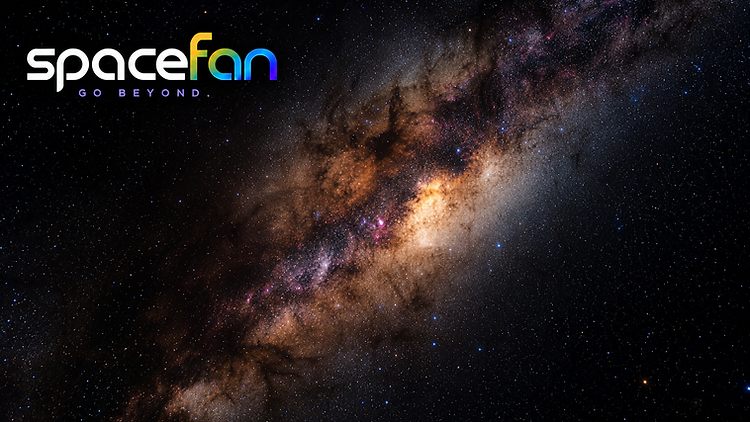
Dense star fields and glowing dust clouds across the center of the Milky Way galaxy.
Image · Space.Fan

The Drop

Our galaxy has a busy, crowded center filled with gas and dust, but it does not produce as many new s as scientists expect. To figure out why, a team of researchers used the ALMA telescope array to take a high-resolution look at this area, known as the Central Molecular Zone. This telescope allows astronomers to peer through thick clouds of dust by detecting radio waves emitted by cold gas. Using this technology, the team scanned the inner 200 s of the galaxy. They developed a special program to scan through the massive amount of data and identified over 1,700 potential spots where s might be born. After cleaning up the list to remove false signals, they settled on a final catalog of 567 reliable candidates. Many of these locations were previously unknown to science. By looking closely at these spots, researchers believe they have found places where baby s are just ting to form, or where larger s are heating up the gas around them. This is the most detailed survey of these -forming zones ever put together.
Advertisement

Why It Matters

This map helps solve a long-standing space mystery. Even though the center of the Milky Way is packed with enough gas to make thousands of s, it has been surprisingly quiet in terms of birth. By identifying exactly where these potential sites are located, astronomers can finally test why the gas is not turning into s faster. This catalog gives them a precise 'to-do list' for future studies to see what is slowing down or triggering the process.
Advertisement

The Catch

While the map is very detailed, many of the spots identified are still just candidates. The researchers classified them based on their shape and light signals, but they cannot say for certain that every single one is an active -forming nursery. Some could be other types of space objects that look similar, such as clumps of gas moved by magnetic fields or other energetic processes.

Put That in Perspective

This study is part of the larger ACES project, which aims to map the gas in our galaxy's center in extreme detail. In the past, it was very difficult to see through the dense dust, but now telescopes like ALMA provide a clear view. Future studies will likely zoom in on these specific 567 locations to see exactly what is happening inside them.

Source September 23, 2026
Jennifer Wallace, Cara Battersby, Nazar Budaiev, H Perry Hatchfield, Ashley T. Barnes, Taehwa Yoo, Miriam G. Santa-Maria, Antonio Daley, Q. Daniel Wang, Anika Schmiedeke
University of Connecticut, University of Florida, European Southern Observatory, University of Massachusetts, Green Bank Observatory·The Astrophysical Journal·10.3847/1538-4357/ae990d

Keep Exploring Space